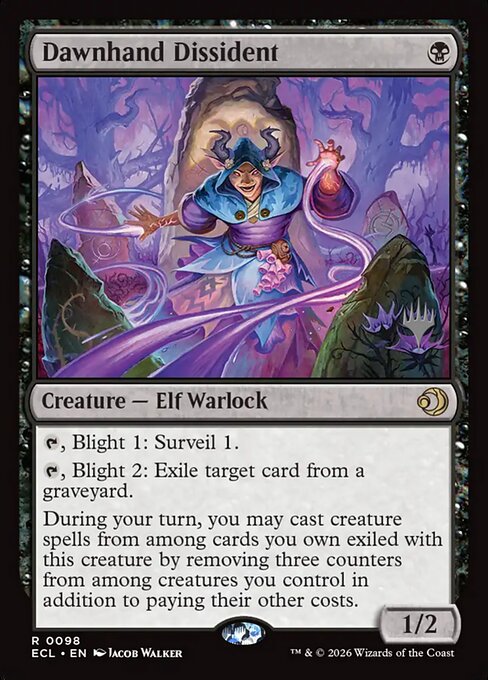
Dawnhand Dissident
Creature — Elf Warlock
Seltenheit
Rare
Manakosten

Künstler
Jacob Walker
Stärke / Widerstandskraft
1 / 2
Regeltext
 , Blight 1: Surveil 1.
, Blight 2: Exile target card from a graveyard.
During your turn, you may cast creature spells from among cards you own exiled with this creature by removing three counters from among creatures you control in addition to paying their other costs.
, Blight 1: Surveil 1.
, Blight 2: Exile target card from a graveyard.
During your turn, you may cast creature spells from among cards you own exiled with this creature by removing three counters from among creatures you control in addition to paying their other costs.
Community
👥
1 Spieler hat diese Karte
🔄
1 bietet sie zum Tausch an
Möchtest du diese Karte tauschen?
Kostenlos registrierenRegeln zu dieser Karte
Rulings (8)
Offizielle Rulings sind nur auf Englisch verfügbar.
-
Wizards of the CoastDawnhand Dissident must be under your control in order for you to start casting a creature spell using its last ability, but it doesn't need to stay under your control throughout that process or be under your control as the spell resolves. If, for example, you sacrifice Dawnhand Dissident to pay an additional cost of the spell or it's destroyed in response, the spell will still resolve normally.
-
Wizards of the CoastAll of the -1/-1 counters must be put on a single creature. You can't choose to split them up between multiple creatures.
-
Wizards of the CoastYou must still pay all costs and follow any timing restrictions and permissions for creature spells you cast from exile this way. Normally, you'll be able to cast them only during your main phase while the stack is empty.
-
Wizards of the CoastIf a creature that has +1/+1 counters on it receives enough -1/-1 counters to cause it to be destroyed by lethal damage or put into its owner's graveyard for having 0 or less toughness, effects that refer to the counters on that creature when it died will see all of those +1/+1 and -1/-1 counters.
-
Wizards of the CoastOnce you've announced that you're casting a spell or activating an ability, players can't take actions until you've finished doing so. Notably, opponents can't try to destroy or otherwise remove your creatures to stop you from blighting as part of paying the cost of that spell or ability.
-
Wizards of the CoastIf a creature has +1/+1 counters and -1/-1 counters on it, state-based actions remove the same number of each so that it has only one kind of those counters on it. For example, if a creature has three +1/+1 counters on it and two -1/-1 counters are put on it, state-based actions will remove two of each of those kinds of counters, leaving the creature with just one +1/+1 counter.
-
Wizards of the CoastThe creature you choose to put -1/-1 counters on doesn't have to have enough toughness to survive the process. For example, if you blight 2, you can choose to put the counters on a 1/1 creature you control.
-
Wizards of the CoastIf you can't place -1/-1 counters on any creatures you control (probably because you control no creatures), you can't choose to blight.