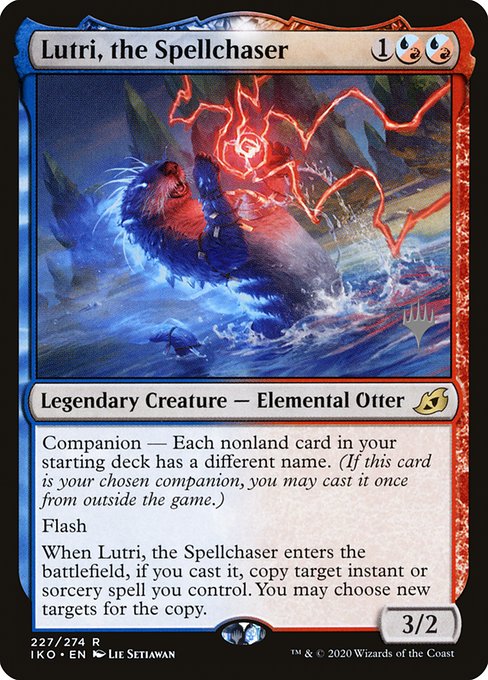
Lutri, the Spellchaser
Legendary Creature — Elemental Otter
Seltenheit
Rare
Manakosten


Künstler
Lie Setiawan
Stärke / Widerstandskraft
3 / 2
Regeltext
Companion — Each nonland card in your starting deck has a different name. (If this card is your chosen companion, you may put it into your hand from outside the game for as a sorcery.)
Flash
When Lutri enters, if you cast it, copy target instant or sorcery spell you control. You may choose new targets for the copy.
as a sorcery.)
Flash
When Lutri enters, if you cast it, copy target instant or sorcery spell you control. You may choose new targets for the copy.
Regeln zu dieser Karte
-
A keyword ability that allows a player to choose one creature card from outside the game as a companion if the restriction of that card’s companion ability is met. Once a player has chosen a companion, that player may pay
to put it into their hand once during the game. See rule 702.139, “Companion.”
-
A keyword ability that lets a player play a card any time they could cast an instant. See rule 702.8, “Flash.”
Rulings (18)
Offizielle Rulings sind nur auf Englisch verfügbar.
-
Wizards of the CoastThe companion ability has no effect if the card is in your starting deck and creates no restriction on putting a card with a companion ability into your starting deck. For example, Zirda may be in your starting deck even if your other permanent cards don't all have activated abilities.
-
Wizards of the CoastThe companion's other abilities apply only if the creature is on the battlefield. They have no effect while the companion is outside the game.
-
Wizards of the CoastIf the spell that's copied is modal (that is, it says "Choose one —" or the like), the copy will have the same mode. A different mode can't be chosen.
-
Wizards of the CoastBefore shuffling your deck to become your library, you may reveal one card from outside the game to be your companion if your starting deck meets the requirements of the companion ability. You can't reveal more than one. It remains revealed outside the game as the game begins.
-
Wizards of the CoastIf you reveal a companion outside the game, for as long as it remains there, you may pay any time you could cast a sorcery (that is, you have priority during your main phase and the stack is empty). Once you do, you put it into your hand and behaves like any other card you've brought into the game. For example, if it's discard, countered, or destroyed, it's put into your graveyard, remaining in the game. This is a change from previous rules.
-
Wizards of the CoastPaying to put your companion into your hand is a special action. It doesn't use the stack and players can't respond to it. Once you take this action, you may cast that card if it's legal to do so before any other player can take actions.
-
Wizards of the CoastThe requirements of the companion ability apply only to your starting deck. They do not apply to your sideboard.
-
Wizards of the CoastThe controller of a copy can't choose to pay any alternative or additional costs for the copy. However, effects based on any alternative or additional costs that were paid for the original spell are copied as though those same costs were paid for the copy.
-
Wizards of the CoastLutri's ability can copy any instant or sorcery spell you control, not just one with targets.
-
Wizards of the CoastThe copy is created on the stack, so it's not "cast." Abilities that trigger when a player casts a spell won't trigger. It will resolve before the original spell does.
-
Wizards of the CoastThe copy will have the same targets as the spell it's copying unless you choose new ones. You may change any number of the targets, including all of them or none of them. If, for one of the targets, you can't choose a new legal target, then it remains unchanged (even if the current target is illegal).
-
Wizards of the CoastYour companion begins the game outside the game. In tournament play, this means your sideboard. In casual play, it's simply a card you own that's not in your starting deck.
-
Wizards of the CoastIf the spell that's copied has an X whose value was determined as it was cast, the copy will have the same value of X.
-
Wizards of the CoastYou may have one companion in the Commander variant. Your deck, including your commander, must meet its companion requirement. Your companion is not one of your one hundred cards.
-
Wizards of the CoastIf more than one player wishes to reveal a companion, the starting player does so first, and players proceed in turn order. Once a player has chosen not to reveal a companion, that player can't change their mind.
-
Wizards of the CoastIf the spell has damage divided as it was cast (like Mythos of Vadrok), the division can't be changed, although the targets receiving that damage still can. The same is true of spells that distribute counters.
-
Wizards of the CoastPaying to put your companion into your hand is a special action. It doesn't use the stack and players can't respond to it. Once you take this action, you may cast that card if it's legal to do so before any other player can take actions.
-
Wizards of the CoastIf you reveal a companion outside the game, for as long as it remains there, you may pay any time you could cast a sorcery (that is, you have priority during your main phase and the stack is empty). Once you do, you put it into your hand and behaves like any other card you've brought into the game. For example, if it's discarded, countered, or destroyed, it's put into your graveyard, remaining in the game. This is a change from previous rules.