Level 6 · Judge-Stoff
Beteiligte Karten

Kopien
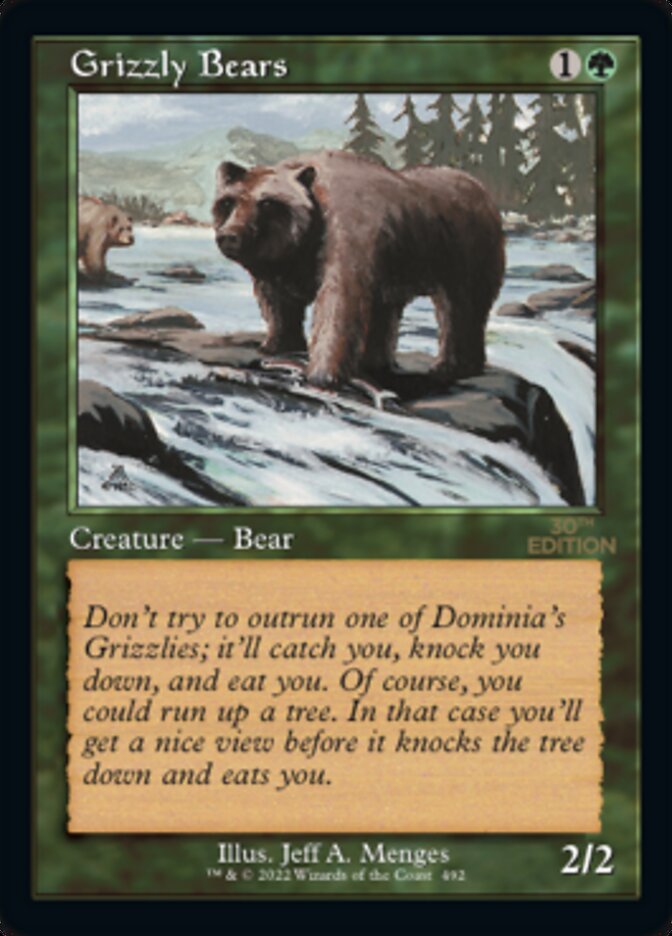
Dein erster Clone liegt als Kopie von Grizzly Bears im Spiel. Jetzt wirkst du einen zweiten Clone und wählst den ersten Clone als Vorlage. Als was kommt der zweite Clone ins Spiel?
Tasten A bis D oder Klick. Keine Zeitbegrenzung.
Ein Kopieeffekt verändert die kopierbaren Werte des Objekts (707.3). Der erste Clone „ist“ für alle weiteren Kopien eine Grizzly Bears, inklusive Name, Manakosten und Fähigkeiten (hier: keine). Der Clone-Text bleibt nicht übrig, er gehört nicht mehr zu den kopierbaren Werten. Ausnahme: Effekte, die ausdrücklich eine Fähigkeit mitgeben („außer er hat diese Fähigkeit“), machen diese Fähigkeit zum Teil der kopierbaren Werte (707.9a).
707.3The copy’s copiable values become the copied information, as modified by the copy’s status (see rule 110.5). Objects that copy the object will use the new copiable values.
707.2When copying an object, the copy acquires the copiable values of the original object’s characteristics and, for an object on the stack, choices made when casting or activating it (mode, targets, the value of X, whether it was kicked, how it will affect multiple targets, and so on). The copiable values are the values derived from the text printed on the object (that text being name, mana cost, color indicator, card type, subtype, supertype, rules text, power, toughness, and/or loyalty), as modified by other copy effects, by its face-down status, and by “as . . . enters” and “as . . . is turned face up” abilities that set power and toughness (and may also set additional characteristics). Other effects (including type-changing and text-changing effects), status, counters, and stickers are not copied.
707.9aSome copy effects cause the copy to gain an ability as part of the copying process. This ability becomes part of the copiable values for the copy, along with any other abilities that were copied.
Beteiligte Karten

Kopien
Helm of the Host erzeugt zu Beginn deines Kampfes einen Spielstein als Kopie der ausgerüsteten legendären Kreatur, „außer dass der Spielstein nicht legendär ist“, und der Spielstein erhält Eile. Später kommt dein Clone als Kopie dieses Spielsteins ins Spiel. Ist der Clone legendär, und hat er Eile?
Tasten A bis D oder Klick. Keine Zeitbegrenzung.
Verändert ein Kopieeffekt eine Charakteristik („außer dass es nicht legendär ist“), wird der veränderte Wert Teil der kopierbaren Werte (707.9b). Der nächste Kopierer übernimmt also „nicht legendär“. „Der Spielstein erhält Eile“ ist kein Teil des Kopiervorgangs, sondern ein eigener Effekt auf diesen Spielstein, und Effekte werden nicht mitkopiert (707.2). Für dich heißt das: Clone und Spielstein dürfen nebeneinander liegen, die Legendenregel (704.5j) greift nicht.
707.9bSome copy effects modify a characteristic as part of the copying process. The final set of values for that characteristic becomes part of the copiable values of the copy.
707.2When copying an object, the copy acquires the copiable values of the original object’s characteristics and, for an object on the stack, choices made when casting or activating it (mode, targets, the value of X, whether it was kicked, how it will affect multiple targets, and so on). The copiable values are the values derived from the text printed on the object (that text being name, mana cost, color indicator, card type, subtype, supertype, rules text, power, toughness, and/or loyalty), as modified by other copy effects, by its face-down status, and by “as . . . enters” and “as . . . is turned face up” abilities that set power and toughness (and may also set additional characteristics). Other effects (including type-changing and text-changing effects), status, counters, and stickers are not copied.
704.5jIf two or more legendary permanents with the same name are controlled by the same player, that player chooses one of them, and the rest are put into their owners’ graveyards. This is called the “legend rule.”
Beteiligte Karten

Kopien
Du wirkst Grizzly Bears und kopierst den Kreaturenzauber mit Double Major. Was passiert mit der Kopie, wenn sie sich verrechnet?
Tasten A bis D oder Klick. Keine Zeitbegrenzung.
Die Kopie eines bleibenden Zauberspruchs wird beim Verrechnen zu einem Spielstein (111.13, 707.10f, 608.3f). Der Spielstein hat die Charakteristika des Zauberspruchs, bleibt dauerhaft und verhält sich wie jeder andere Spielstein: Verlässt er das Schlachtfeld, hört er beim nächsten Prüfen der zustandsbasierten Aktionen auf zu existieren (704.5d). Weil er nicht „erzeugt“ wird, verdoppeln Doubling Season oder Anointed Procession ihn nicht.
111.13A copy of a permanent spell becomes a token as it resolves. The token has the characteristics of the spell that became that token. The token is not “created” for the purposes of any replacement effects or triggered abilities that refer to creating a token.
707.10fSome effects copy a permanent spell. As that copy resolves, it ceases being a copy of a spell and becomes a token permanent. (See rule 608.3f.)
608.3fIf the object that’s resolving is a copy of a permanent spell, it will become a token permanent as it is put onto the battlefield in any of the steps above. A token put onto the battlefield this way is no longer a copy of a spell and is not “created” for the purposes of any rules or effects that refer to creating a token.
704.5dIf a token is in a zone other than the battlefield, it ceases to exist.
Beteiligte Karten

Kopien
Dein Clone kommt als Kopie von Wall of Omens („Wenn diese Kreatur ins Spiel kommt, ziehe eine Karte“) ins Spiel. Ziehst du eine Karte?
Tasten A bis D oder Klick. Keine Zeitbegrenzung.
„Kommt als Kopie ins Spiel“ heißt: Der Kopieeffekt gilt schon beim Betreten (707.5). Darum wirken auch „kommt getappt ins Spiel“ oder „kommt mit Marken ins Spiel“ der Vorlage, und Kommt-ins-Spiel-Fähigkeiten lösen aus (603.6a). Anders bei Effekten, die eine bereits liegende bleibende Karte zur Kopie machen (Cytoshape, Unstable Shapeshifter): Da kommt nichts ins Spiel, also kein Trigger (707.4). Die alte Wall löst nicht erneut aus, sie ist nicht ins Spiel gekommen.
707.5An object that enters the battlefield “as a copy” or “that’s a copy” of another object becomes a copy as it enters the battlefield. It doesn’t enter the battlefield, and then become a copy of that permanent. If the text that’s being copied includes any abilities that replace the enters-the-battlefield event (such as “enters with” or “as [this] enters” abilities), those abilities will take effect. Also, any enters-the-battlefield triggered abilities of the copy will have a chance to trigger.
603.6aEnters-the-battlefield abilities trigger when a permanent enters the battlefield. These are written, “When [this object] enters, . . . “ or “Whenever a [type] enters, . . .” Each time an event puts one or more permanents onto the battlefield, all permanents on the battlefield (including the newcomers) are checked for any enters-the-battlefield triggers that match the event.
707.4Some effects cause a permanent that’s copying a permanent to copy a different object while remaining on the battlefield. The change doesn’t cause enters-the-battlefield or leaves-the-battlefield abilities to trigger. This also doesn’t change any noncopy effects presently affecting the permanent.
Beteiligte Karten
Kopien
Aussage
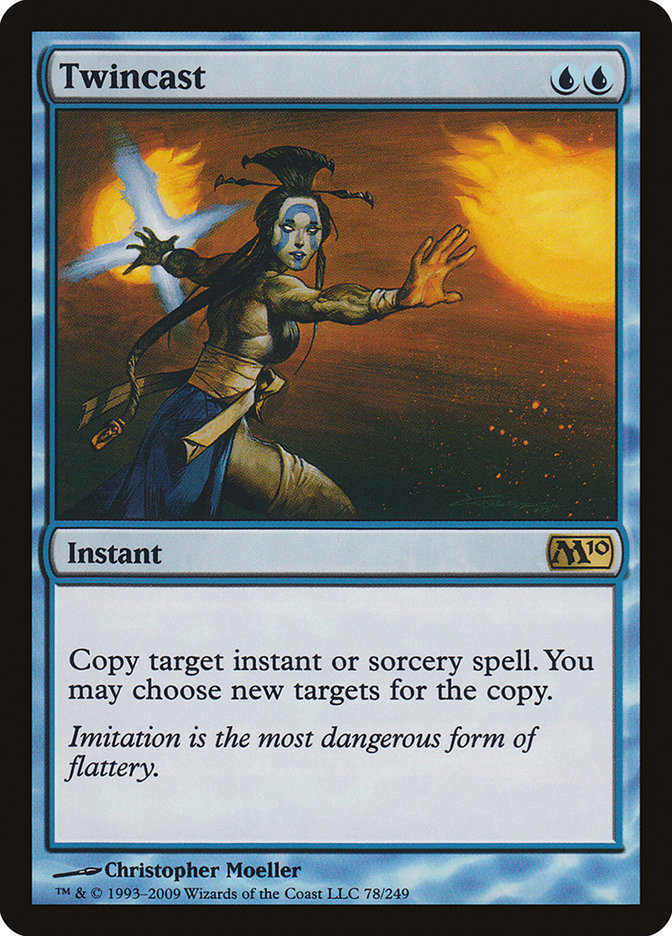
„Wird die mit Twincast erzeugte Kopie eines Zauberspruchs neutralisiert, liegt sie danach als Karte im Friedhof ihres Besitzers. "
Wähle eine Antwort — dann geht es weiter.
Eine Spruchkopie existiert nur auf dem Stack. Verlässt sie ihn, egal ob durch Verrechnen, Neutralisieren oder Verpuffen, hört sie beim nächsten Prüfen der zustandsbasierten Aktionen auf zu existieren (707.10a, 704.5e). Es gibt keine Karte, die irgendwohin könnte. Die Kopie wurde auch nie gewirkt (707.10), sie wurde erzeugt.
707.10aIf a copy of a spell is in a zone other than the stack, it ceases to exist. If a copy of a card is in any zone other than the stack or the battlefield, it ceases to exist. These are state-based actions. See rule 704.
704.5eIf a copy of a spell is in a zone other than the stack, it ceases to exist. If a copy of a card is in any zone other than the stack or the battlefield, it ceases to exist.
707.10To copy a spell, activated ability, or triggered ability means to put a copy of it onto the stack; a copy of a spell isn’t cast and a copy of an activated ability isn’t activated. A copy of a spell or ability copies both the characteristics of the spell or ability and all decisions made for it, including modes, targets, the value of X, and additional or alternative costs. (See rule 601, “Casting Spells.”) Choices that are normally made on resolution are not copied. If an effect of the copy refers to objects used to pay its costs, it uses the objects used to pay the costs of the original spell or ability. A copy of a spell is owned by the player under whose control it was put on the stack. A copy of a spell or ability is controlled by the player under whose control it was put on the stack. A copy of a spell is itself a spell, even though it has no spell card associated with it. A copy of an ability is itself an ability.
Beteiligte Karten


Doppelseitige Karten
Dein Delver of Secrets hat sich in Insectile Aberration verwandelt. Auf der Rückseite sind keine Manakosten aufgedruckt. Welchen Manabetrag hat die Aberration jetzt, etwa für Fatal Push („Zerstöre eine Kreatur deiner Wahl, falls ihr Manabetrag 2 oder weniger ist“)?
Tasten A bis D oder Klick. Keine Zeitbegrenzung.
Liegt eine nichtmodale doppelseitige Karte mit der Rückseite oben, hat sie nur die Charakteristika der Rückseite, aber ihr Manabetrag wird aus den Manakosten der Vorderseite berechnet (712.8e, 202.3b). Insectile Aberration hat Manabetrag 1. Sonderfall: Kopiert ein Clone die Rückseite, hat die Kopie Manabetrag 0, weil sie keine Vorderseite hat, aus der sich etwas ableiten ließe (712.8e).
712.8eWhile a nonmodal double-faced permanent has its back face up, it has only the characteristics of its back face. However, its mana value is calculated using the mana cost of its front face. If a permanent is copying the back face of a nonmodal double-faced permanent (even if the object representing that copy is itself a double-faced permanent), the mana value of that permanent is 0. See rule 202.3b.
202.3bThe mana value of the back face of a nonmodal double-faced permanent or spell’s back face is calculated as though it had the mana cost of its front face. If a permanent or spell is a copy of the back face of a nonmodal double-faced object (even if the card representing that copy is itself a double-faced card), the mana value of the copy is 0.
Beteiligte Karten

Doppelseitige Karten
Jwari Disruption // Jwari Ruins ist eine modale doppelseitige Karte: vorne ein Spontanzauber, hinten ein Land. Du verrechnest „Durchsuche deine Bibliothek nach einer Landkarte“. Darfst du Jwari Disruption nehmen?
Tasten A bis D oder Klick. Keine Zeitbegrenzung.
Außerhalb von Schlachtfeld und Stack zählt nur die Vorderseite (712.8a). Jwari Disruption ist in Bibliothek, Hand und Friedhof ein Spontanzauber, keine Landkarte. Von der Hand darfst du sie trotzdem als Land spielen: Beim Spielen wählst du die Landseite (712.12), das verbraucht deinen Landdrop. Für die Farbidentität im Commander zählt die Rückseite dagegen mit (903.4d).
712.8aWhile a double-faced card is outside the game or in a zone other than the battlefield or stack, it has only the characteristics of its front face.
712.12A player playing a modal double-faced card or a copy of a modal double-faced card as a land chooses one of its faces that’s a land before putting it onto the battlefield. It enters the battlefield with that face up. See rule 305, “Lands.”
903.4dThe back face of a double-faced card (see rule 712) is included when determining a card’s color identity. This is an exception to rule 712.8a.
Beteiligte Karten

Doppelseitige Karten
Deine Insectile Aberration (transformierter Delver of Secrets) soll vor einem Removal gerettet werden. Du wirkst Cloudshift: Schicke sie ins Exil und bringe sie sofort zurück. Wie kommt sie zurück?
Tasten A bis D oder Klick. Keine Zeitbegrenzung.
Beim Zonenwechsel wird die Karte ein neues Objekt ohne Erinnerung an vorher (400.7). Im Exil hat sie nur die Vorderseite (712.8a), und beim Zurückkommen von irgendwo außer vom Stack liegt sie mit der Vorderseite oben (712.14), außer ein Effekt sagt ausdrücklich „transformiert“ (712.14a). Dein 3/2-Flieger ist also wieder ein 1/1 Delver und muss sich neu verwandeln. Dasselbe gilt für den Friedhof: Dort liegt Delver of Secrets, keine Aberration.
712.14A double-faced card put onto the battlefield from a zone other than the stack enters the battlefield with its front face up by default.
712.8aWhile a double-faced card is outside the game or in a zone other than the battlefield or stack, it has only the characteristics of its front face.
400.7An object that moves from one zone to another becomes a new object with no memory of, or relation to, its previous existence. This rule has the following exceptions.
712.14aIf a spell or ability puts a double-faced card onto the battlefield “transformed” or “converted,” it enters the battlefield with its back face up. If a player is instructed to put a card that isn’t a double-faced card onto the battlefield transformed or converted, that card stays in its current zone.
Beteiligte Karten
Doppelseitige Karten
Dein Clone kommt als Kopie der Insectile Aberration deines Gegners (Rückseite von Delver of Secrets) ins Spiel. Was ist dein Clone?
Tasten A bis D oder Klick. Keine Zeitbegrenzung.
Kopiert wird die aktuell oben liegende Seite (707.8). Clone ist eine Insectile Aberration, aber: Er hat keine Vorderseite, aus der sich ein Manabetrag ableiten ließe, also Manabetrag 0 (712.8e), und als normale Karte kann er nicht transformieren (712.9). Anders bei Spielstein-Kopien: Erzeugt ein Effekt einen Spielstein als Kopie einer doppelseitigen Karte, bekommt der Spielstein beide Seiten und kann transformieren (707.8a, siehe Trainer).
707.8When copying a melded permanent or other double-faced permanent, use the copiable values of the face that’s currently up to determine the characteristics of the copy. See rule 712, “Double-Faced Cards.”
712.8eWhile a nonmodal double-faced permanent has its back face up, it has only the characteristics of its back face. However, its mana value is calculated using the mana cost of its front face. If a permanent is copying the back face of a nonmodal double-faced permanent (even if the object representing that copy is itself a double-faced permanent), the mana value of that permanent is 0. See rule 202.3b.
712.9Only permanents represented by double-faced tokens and double-faced cards that are not meld cards can transform or convert. (See rule 701.27, “Transform,” and rule 701.28, “Convert.”) If a spell or ability instructs a player to transform or convert any permanent that isn’t represented by a double-faced token or a double-faced card, nothing happens.
707.8aIf an effect creates a token that is a copy of a double-faced permanent or a double-faced card not on the battlefield, the resulting token is a double-faced token that has both a front face and a back face. The characteristics of each face are determined by the copiable values of the same face of the permanent or card it is a copy of, as modified by any other copy effects that apply to that object. If the token is a copy of a double-faced permanent with its back face up, the token enters the battlefield with its back face up. This rule does not apply to tokens that are created with their own set of characteristics and enter the battlefield as a copy of a double-faced object due to a replacement effect.
Beteiligte Karten

Doppelseitige Karten
Aussage
„Dein Delver of Secrets hat +3/+3 von Giant Growth. Transformiert er sich noch in diesem Zug durch einen Effekt, verliert er den Bonus, weil er ein neues Objekt wird. "
Wähle eine Antwort — dann geht es weiter.
Beim Transformieren bleibt die bleibende Karte dasselbe Objekt (712.18): Giant Growth wirkt weiter, Marken, Auren und Ausrüstung bleiben, sie bekommt keine neue Einsatzverzögerung und löst kein „kommt ins Spiel“ aus. Transformieren ist auch kein Umdrehen im Sinne von Morph (701.27b). Ein neues Objekt entsteht nur beim Zonenwechsel (400.7), etwa bei Cloudshift.
712.18When a double-faced permanent transforms or converts, it doesn’t become a new object. Any effects that applied to that permanent will continue to apply to it.
400.7An object that moves from one zone to another becomes a new object with no memory of, or relation to, its previous existence. This rule has the following exceptions.
701.27bAlthough transforming a permanent uses the same physical action as turning a permanent face up or face down, they are different game actions. Abilities that trigger when a permanent is turned face down won’t trigger when that permanent transforms, and so on.
Beteiligte Karten

Commander
Tatsumasa, the Dragon’s Fang ist ein farbloses Artefakt mit dem Text „ , schicke Tatsumasa ins Exil: Erzeuge einen 5/5 blauen Drachen-Geist-Kreaturenspielstein mit Fliegend“. Darfst du es in einem Deck mit rein weißem Kommandeur spielen?
Tasten A bis D oder Klick. Keine Zeitbegrenzung.
Farbidentität = Farben aller Manasymbole in Manakosten und Regeltext plus Farbindikator und farbdefinierende Fähigkeiten (903.4). Wörter wie „blau“ zählen nicht, Erinnerungstext ebenfalls nicht (903.4c). Gegenbeispiel Bosh, Iron Golem: farbloses Artefakt mit 
 im Text, Identität rot. Ob der Spielstein im Spiel blau ist, spielt keine Rolle, die Identität wird vor dem Spiel festgelegt (903.4a) und entscheidet über die Decklegalität (903.5c).
903.4The Commander variant uses color identity to determine what cards can be in a deck with a certain commander. The color identity of a card is the color or colors of any mana symbols in that card’s mana cost or rules text, plus any colors defined by its characteristic-defining abilities (see rule 604.3) or color indicator (see rule 204).
903.4cReminder text is ignored when determining a card’s color identity. See rule 207.2.
903.5cA card can be included in a Commander deck only if every color in its color identity is also found in the color identity of the deck’s commander.
903.4aColor identity is established before the game begins. If a rule or effect refers to the color identity of an object in the game represented by a card, it uses the color identity established for that card as the game began.
Beteiligte Karten

Commander
Westvale Abbey ist ein Land ohne farbige Manasymbole im Text. Seine Rückseite Ormendahl, Profane Prince hat einen schwarzen Farbindikator. Darf das Land in ein Deck mit rein weißem Kommandeur?
Tasten A bis D oder Klick. Keine Zeitbegrenzung.
Normalerweise hat eine doppelseitige Karte außerhalb von Schlachtfeld und Stack nur die Vorderseite (712.8a). Die Farbidentität ist die ausdrückliche Ausnahme: Beide Seiten zählen (903.4d), inklusive Farbindikator (903.4). Ormendahl macht das Land schwarz, es darf nur in Decks, deren Kommandeur Schwarz in der Identität hat (903.5c). Dasselbe gilt für Abenteuer-Hälften (903.4e).
903.4dThe back face of a double-faced card (see rule 712) is included when determining a card’s color identity. This is an exception to rule 712.8a.
903.4The Commander variant uses color identity to determine what cards can be in a deck with a certain commander. The color identity of a card is the color or colors of any mana symbols in that card’s mana cost or rules text, plus any colors defined by its characteristic-defining abilities (see rule 604.3) or color indicator (see rule 204).
903.5cA card can be included in a Commander deck only if every color in its color identity is also found in the color identity of the deck’s commander.
712.8aWhile a double-faced card is outside the game or in a zone other than the battlefield or stack, it has only the characteristics of its front face.
Beteiligte Karten


Commander
Du kontrollierst Blood Artist. Dein Gegner tötet deinen Kommandeur mit Doom Blade, und du legst ihn in die Kommandozone. Löst Blood Artist („Immer wenn Blood Artist oder eine andere Kreatur stirbt“) aus?
Tasten A bis D oder Klick. Keine Zeitbegrenzung.
Seit der Regeländerung 2020 ist der Weg aus Friedhof oder Exil in die Kommandozone eine zustandsbasierte Aktion (903.9a, 704.6d): Der Kommandeur geht wirklich in den Friedhof, „stirbt“-Fähigkeiten wie Blood Artist lösen aus, danach darfst du ihn umlegen. Für Hand und Bibliothek gilt dagegen ein Ersetzungseffekt (903.9b): Unsummon auf den Kommandeur bringt ihn direkt in die Kommandozone, er war nie auf der Hand.
903.9aIf a commander is in a graveyard or in exile and that object was put into that zone since the last time state-based actions were checked, its owner may put it into the command zone. This is a state-based action. See rule 704.
704.6dIn a Commander game, if a commander is in a graveyard or in exile and that object was put into that zone since the last time state-based actions were checked, its owner may put it into the command zone. See rule 903, “Commander.”
903.9bIf a commander would be put into its owner’s hand or library from anywhere, its owner may put it into the command zone instead. This replacement effect may apply more than once to the same event. This is an exception to rule 614.5.
Commander
Aussage
„Dein Gegner hat dir mit Partner-Kommandeur A 11 Kampfschaden und mit Partner-Kommandeur B 10 Kampfschaden zugefügt. Du hast damit verloren. "
Wähle eine Antwort — dann geht es weiter.
Die 21-Schaden-Regel zählt pro Kommandeur: Ein Spieler verliert, wenn ihm derselbe Kommandeur im Laufe des Spiels 21 oder mehr Kampfschaden zugefügt hat (903.10a, 704.6c). Zwei Partner werden getrennt gezählt, 11 und 10 reichen nicht. Und eine Kopie des Kommandeurs (Clone, Body Double) ist kein Kommandeur, ihr Schaden zählt gar nicht (903.3).
903.10aA player who’s been dealt 21 or more combat damage by the same commander over the course of the game loses the game. (This is a state-based action. See rule 704.)
704.6cIn a Commander game, a player who’s been dealt 21 or more combat damage by the same commander over the course of the game loses the game. See rule 903, “Commander.”
903.3Each deck has a legendary card designated as its commander. That card must be either (a) a creature card, (b) a Vehicle card, or (c) a Spacecraft card with one or more power/toughness boxes. This designation is not a characteristic of the object represented by the card; rather, it is an attribute of the card itself. The card retains this designation even when it changes zones.
Commander
Vierer-Runde Commander. Deine Starthand gefällt dir nicht, du nimmst einen Mulligan. Wie viele Karten ziehst du, und wie viele legst du unter die Bibliothek?
Tasten A bis D oder Klick. Keine Zeitbegrenzung.
London-Mulligan: Du mischst, ziehst wieder sieben und legst so viele Karten unter die Bibliothek, wie du Mulligans genommen hast (103.5). In Mehrspieler-Partien zählt der erste Mulligan nicht mit (103.5c), er ist kostenlos; der zweite kostet dann eine Karte, der dritte zwei. Achtung: Das hängt an „Mehrspieler“, nicht an „Commander“. In einer Commander-Partie zu zweit kostet schon der erste Mulligan eine Karte, sofern das Turnierformat nichts anderes vorsieht.
103.5Each player draws a number of cards equal to their starting hand size, which is normally seven. (Some effects can modify a player’s starting hand size.) A player who is dissatisfied with their initial hand may take a mulligan. First, the starting player declares whether they will take a mulligan. Then each other player in turn order does the same. Once each player has made a declaration, all players who decided to take mulligans do so at the same time. To take a mulligan, a player shuffles the cards in their hand back into their library, draws a new hand of cards equal to their starting hand size, then puts a number of those cards equal to the number of times that player has taken a mulligan on the bottom of their library in any order. Once a player chooses not to take a mulligan, the remaining cards become that player’s opening hand, and that player may not take any further mulligans. This process is then repeated until no player takes a mulligan. A player can take mulligans until their opening hand would be zero cards, after which they may not take further mulligans.
103.5cIn a multiplayer game and in any Brawl game, the first mulligan a player takes doesn’t count toward the number of cards that player will put on the bottom of their library or the number of mulligans that player may take. Subsequent mulligans are counted toward these numbers as normal.
Beteiligte Karten

Zustandsbasierte Aktionen
Deine Bibliothek ist leer, und du kontrollierst keinen Laboratory Maniac. Du verrechnest einen Zauberspruch mit „Ziehe zwei Karten, danach erhältst du 5 Lebenspunkte dazu“. Wann verlierst du das Spiel?
Tasten A bis D oder Klick. Keine Zeitbegrenzung.
Wer aus einer leeren Bibliothek ziehen will, zieht einfach nichts (121.4). Verloren wird erst, wenn das Spiel die zustandsbasierten Aktionen prüft: unmittelbar bevor ein Spieler Priorität bekommen würde, nie mitten in der Verrechnung (704.3, 704.4, 704.5b). Genau in dieses Fenster passt Laboratory Maniac: Sein Ersetzungseffekt macht aus dem Ziehversuch einen Sieg, bevor die Prüfung überhaupt stattfindet.
704.5bIf a player attempted to draw a card from a library with no cards in it since the last time state-based actions were checked, that player loses the game.
121.4A player who attempts to draw a card from a library with no cards in it loses the game the next time a player would receive priority. (This is a state-based action. See rule 704.)
704.3Whenever a player would get priority (see rule 117, “Timing and Priority”), the game checks for any of the listed conditions for state-based actions, then performs all applicable state-based actions simultaneously as a single event. If any state-based actions are performed as a result of a check, the check is repeated; otherwise all triggered abilities that are waiting to be put on the stack are put on the stack, then the check is repeated. Once no more state-based actions have been performed as the result of a check and no triggered abilities are waiting to be put on the stack, the appropriate player gets priority. This process also occurs during the cleanup step (see rule 514), except that if no state-based actions are performed as the result of the step’s first check and no triggered abilities are waiting to be put on the stack, then no player gets priority and the step ends.
704.4Unlike triggered abilities, state-based actions pay no attention to what happens during the resolution of a spell or ability.
Beteiligte Karten
Zustandsbasierte Aktionen
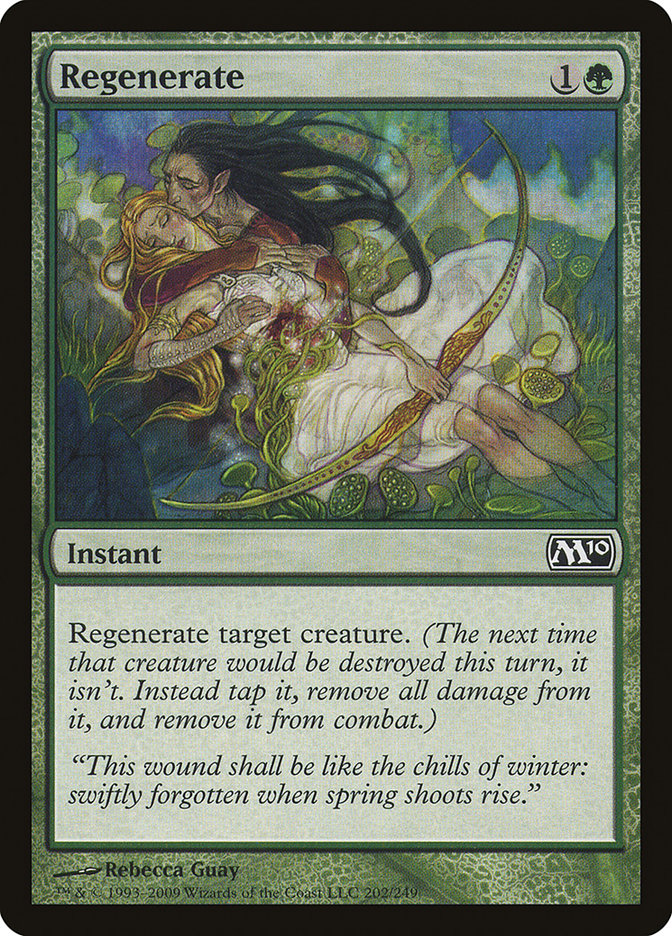
Dein Gegner legt mit einem Effekt zwei -1/-1-Marken auf deine Grizzly Bears (2/2). Du hast Regenerate und offenes Mana. Kannst du die Bären retten?
Tasten A bis D oder Klick. Keine Zeitbegrenzung.
Zustandsbasierte Aktionen unterscheiden drei Fälle: Widerstandskraft 0 oder weniger, dann ab in den Friedhof, ohne Zerstörung (704.5f). Schaden in Höhe der Widerstandskraft oder Schaden von einer Quelle mit Todesberührung, dann wird die Kreatur zerstört (704.5g, 704.5h). Regeneration ersetzt nur Zerstörung (701.19a), Unzerstörbarkeit verhindert nur Zerstörung. Gegen Widerstandskraft 0 hilft nur, die Widerstandskraft zu erhöhen, etwa mit Giant Growth als Antwort.
704.5fIf a creature has toughness 0 or less, it’s put into its owner’s graveyard. Regeneration can’t replace this event.
704.5gIf a creature has toughness greater than 0, it has damage marked on it, and the total damage marked on it is greater than or equal to its toughness, that creature has been dealt lethal damage and is destroyed. Regeneration can replace this event.
704.5hIf a creature has toughness greater than 0, and it’s been dealt damage by a source with deathtouch since the last time state-based actions were checked, that creature is destroyed. Regeneration can replace this event.
701.19aIf the effect of a resolving spell or ability regenerates a permanent, it creates a replacement effect that protects the permanent the next time it would be destroyed this turn. In this case, “Regenerate [permanent]” means “The next time [permanent] would be destroyed this turn, instead remove all damage marked on it and its controller taps it. If it’s an attacking or blocking creature, remove it from combat.”
Beteiligte Karten


Zustandsbasierte Aktionen
Dein animiertes Mutavault (2/2 bis zum Ende des Zuges) trägt Bonesplitter und ist mit Rancor verzaubert. Der Zug endet, Mutavault ist nur noch ein Land. Was passiert mit Ausrüstung und Aura?
Tasten A bis D oder Klick. Keine Zeitbegrenzung.
Eine Aura, die etwas Illegales verzaubert, geht in den Friedhof ihres Besitzers (704.5m, 303.4c). „Verzaubere eine Kreatur“ ist auf einem reinen Land nicht mehr erfüllt. Rancors Fähigkeit („Wenn diese Aura vom Schlachtfeld in einen Friedhof gelegt wird“) bringt es auf die Hand. Eine Ausrüstung an einer illegalen bleibenden Karte wird nur gelöst und bleibt liegen (704.5n, 301.5c); du kannst später neu ausrüsten.
704.5mIf an Aura is attached to an illegal object or player, or is not attached to an object or player, that Aura is put into its owner’s graveyard.
303.4cIf an Aura is enchanting an illegal object or player as defined by its enchant ability and other applicable effects, the object it was attached to no longer exists, or the player it was attached to has left the game, the Aura is put into its owner’s graveyard. (This is a state-based action. See rule 704.)
704.5nIf an Equipment or Fortification is attached to an illegal permanent or to a player, it becomes unattached from that permanent or player. It remains on the battlefield.
301.5cAn Equipment that’s also a creature can’t equip a creature unless that Equipment has reconfigure (see rule 702.151, “Reconfigure”). An Equipment that loses the subtype “Equipment” can’t equip a creature. An Equipment can’t equip itself. An Equipment that equips an illegal or nonexistent permanent becomes unattached from that permanent but remains on the battlefield. (This is a state-based action. See rule 704.) An Equipment can’t equip more than one creature. If a spell or ability would cause an Equipment to equip more than one creature, the Equipment’s controller chooses which creature it equips.
Beteiligte Karten


Zustandsbasierte Aktionen
Auf History of Benalia kommt die dritte Sagenmarke, Kapitel III („Ritter, die du kontrollierst, erhalten +2/+1“) löst aus. Dein Gegner neutralisiert die Kapitelfähigkeit mit Stifle. Was passiert mit der Saga?
Tasten A bis D oder Klick. Keine Zeitbegrenzung.
Das Opfern einer Saga ist keine Fähigkeit, sondern eine zustandsbasierte Aktion (704.5s, 714.4): Marken mindestens gleich der letzten Kapitelnummer und keine Kapitelfähigkeit dieser Saga mehr auf dem Stack. Solange Kapitel III auf dem Stack liegt (714.2b), bleibt die Saga, man kann sie noch zerstören oder kopieren. Verlässt der Trigger den Stack, egal ob verrechnet oder neutralisiert, wird geopfert. Stifle kann das Opfern nicht neutralisieren, weil es nie auf dem Stack liegt.
704.5sIf the number of lore counters on a Saga permanent with one or more chapter abilities is greater than or equal to its final chapter number and it isn’t the source of a chapter ability that has triggered but not yet left the stack, that Saga’s controller sacrifices it. See rule 714, “Saga Cards.”
714.4If the number of lore counters on a Saga permanent with one or more chapter abilities is greater than or equal to its final chapter number, and it isn’t the source of a chapter ability that has triggered but not yet left the stack, that Saga’s controller sacrifices it. This state-based action doesn’t use the stack.
714.2b“{rN}—[Effect]” means “When one or more lore counters are put onto this Saga, if the number of lore counters on it was less than N and became at least N, [effect].”
Beteiligte Karten
Zustandsbasierte Aktionen
Aussage
„Ein Kreaturenspielstein, der stirbt, löst „Immer wenn eine Kreatur stirbt“-Fähigkeiten wie Blood Artist aus, obwohl er gleich darauf aufhört zu existieren. "
Wähle eine Antwort — dann geht es weiter.
Der Spielstein wird tatsächlich in den Friedhof gelegt und erst beim nächsten Prüfen der zustandsbasierten Aktionen aus dem Spiel genommen (704.5d, 111.7). Der Zonenwechsel findet statt, alle „stirbt“-Fähigkeiten lösen aus. Was nicht geht: den Spielstein aus dem Friedhof zurückholen. Versucht ein Effekt das, bleibt er, wo er ist, und verschwindet (111.8).
704.5dIf a token is in a zone other than the battlefield, it ceases to exist.
111.7A token that’s in a zone other than the battlefield ceases to exist. This is a state-based action; see rule 704. (Note that if a token changes zones, applicable triggered abilities will trigger before the token ceases to exist.)
111.8A token that has left the battlefield can’t move to another zone or come back onto the battlefield. If such a token would change zones, it remains in its current zone instead. It ceases to exist the next time state-based actions are checked; see rule 704.