Level 1 · Grundlagen
Beteiligte Karten


Timing
Dein Gegner greift mit Centaur Courser (3/3) an. Du hältst Lightning Bolt (Spontanzauber,  ). Darfst du ihn jetzt wirken, um den Angreifer zu töten?
Tasten A bis D oder Klick. Keine Zeitbegrenzung.
Spontanzauber dürfen immer gewirkt werden, wenn du Priorität hast, also auch im Zug des Gegners und in jedem Kampfsegment. Dass der Stack leer ist, spielt nur für Hexereien eine Rolle. Nach der Angriffserklärung bekommt der aktive Spieler Priorität, passt er, bist du dran. 3 Schaden töten den 3/3, bevor er Kampfschaden zufügt.
117.1aA player may cast an instant spell any time they have priority. A player may cast a noninstant spell during their main phase any time they have priority and the stack is empty.
304.1A player who has priority may cast an instant card from their hand. Casting an instant as a spell uses the stack. (See rule 601, “Casting Spells.”)
117.3aThe active player receives priority at the beginning of most steps and phases, after any turn-based actions (such as drawing a card during the draw step; see rule 703) have been dealt with and abilities that trigger at the beginning of that phase or step have been put on the stack. No player receives priority during the untap step. Players usually don’t get priority during the cleanup step (see rule 514.3).
Timing
Markiere alle Abschnitte deines eigenen Zugs, in denen du eine Hexerei wirken darfst (Stack leer).
Mehrfachauswahl: alle passenden Abschnitte markieren, dann prüfen.
Hexereien nur in deiner Hauptphase 1 oder 2, und nur wenn der Stack leer ist. Im Enttappsegment bekommt niemand Priorität, im Aufräumsegment normalerweise auch nicht.
307.1A player who has priority may cast a sorcery card from their hand during a main phase of their turn when the stack is empty. Casting a sorcery as a spell uses the stack. (See rule 601, “Casting Spells.”)
505.1There are two main phases in a turn. In each turn, the first main phase (also known as the precombat main phase) and the second main phase (also known as the postcombat main phase) are separated by the combat phase (see rule 506, “Combat Phase”). The precombat and postcombat main phases are individually and collectively known as the main phase.
502.4No player receives priority during the untap step, so no spells can be cast or resolve and no abilities can be activated or resolve. Any ability that triggers during this step will be held until the next time a player would receive priority, which is usually during the upkeep step. (See rule 503, “Upkeep Step.”)
514.3Normally, no player receives priority during the cleanup step, so no spells can be cast and no abilities can be activated. However, this rule is subject to the following exception:
Beteiligte Karten


Timing
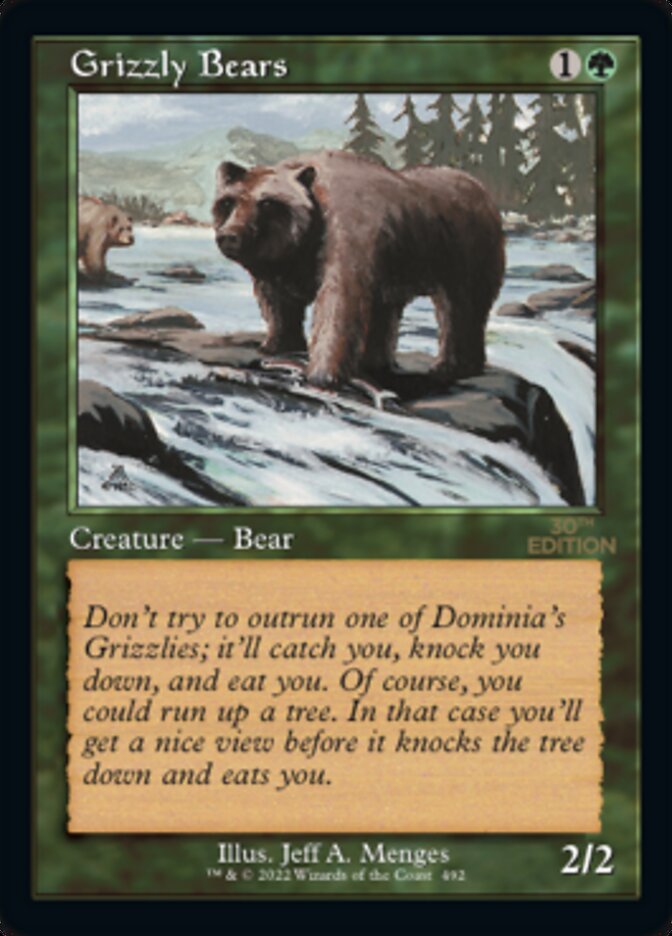
Dein Gegner wirkt Lightning Strike auf deine Grizzly Bears (2/2). Du hältst Giant Growth (+3/+3). Kannst du die Bären noch retten?
Tasten A bis D oder Klick. Keine Zeitbegrenzung.
Nach dem Wirken bekommt der Gegner zuerst Priorität, passt er, bist du dran. Giant Growth geht über Lightning Strike auf den Stack und wird zuerst verrechnet: Die Bären sind 5/5, die 3 Schaden reichen nicht mehr. Erst wenn beide nacheinander passen, wird das oberste Objekt verrechnet.
117.1aA player may cast an instant spell any time they have priority. A player may cast a noninstant spell during their main phase any time they have priority and the stack is empty.
117.3cIf a player has priority when they cast a spell, activate an ability, or take a special action, that player receives priority afterward.
117.4If all players pass in succession (that is, if all players pass without taking any actions in between passing), the spell or ability on top of the stack resolves or, if the stack is empty, the phase or step ends.
Timing
Dein Gegner ist am Zug. In welchen Abschnitten seines Zugs bekommst du Priorität und kannst einen Spontanzauber wirken?
Mehrfachauswahl: alle passenden Abschnitte markieren, dann prüfen.
In jedem Segment und jeder Phase, in der Spieler Priorität bekommen, bekommt sie zuerst der aktive Spieler. Passt er, bekommst du Priorität. Ein Abschnitt endet erst, wenn alle Spieler nacheinander gepasst haben. Dein Gegner kann also kein Segment „überspringen", ohne dir Priorität zu geben. Ausnahmen: Im Enttappsegment bekommt niemand Priorität, im Aufräumsegment normalerweise auch nicht.
117.1aA player may cast an instant spell any time they have priority. A player may cast a noninstant spell during their main phase any time they have priority and the stack is empty.
117.3aThe active player receives priority at the beginning of most steps and phases, after any turn-based actions (such as drawing a card during the draw step; see rule 703) have been dealt with and abilities that trigger at the beginning of that phase or step have been put on the stack. No player receives priority during the untap step. Players usually don’t get priority during the cleanup step (see rule 514.3).
117.3dIf a player has priority and chooses not to take any actions, that player passes. If any mana is in that player’s mana pool, they announce what mana is there. Then the next player in turn order receives priority.
117.4If all players pass in succession (that is, if all players pass without taking any actions in between passing), the spell or ability on top of the stack resolves or, if the stack is empty, the phase or step ends.
502.4No player receives priority during the untap step, so no spells can be cast or resolve and no abilities can be activated or resolve. Any ability that triggers during this step will be held until the next time a player would receive priority, which is usually during the upkeep step. (See rule 503, “Upkeep Step.”)
514.3Normally, no player receives priority during the cleanup step, so no spells can be cast and no abilities can be activated. However, this rule is subject to the following exception:
Beteiligte Karten

Fähigkeits-Arten
 : Erzeuge
 .
Welche Art von Fähigkeit ist die markierte Zeile?
Tasten A bis D oder Klick. Keine Zeitbegrenzung.
Aktivierte Fähigkeit im Muster „Kosten: Effekt". Weil sie Mana erzeugen kann, kein Ziel hat und keine Loyalitätsfähigkeit ist, ist sie eine Mana-Fähigkeit und wird sofort verrechnet. Du kannst sie sogar mitten im Bezahlen eines Spruchs aktivieren.
602.1Activated abilities have a cost and an effect. They are written as “[Cost]: [Effect.] [Activation instructions (if any).]”
605.1aAn activated ability is a mana ability if it meets all of the following criteria: it doesn’t require a target (see rule 115.6), it could add mana to a player’s mana pool when it resolves, it’s not a loyalty ability (see rule 606, “Loyalty Abilities”), and its cost and effect don’t move any card to or from a library. Do not take into account replacement effects that may apply, other than self-replacement effects, when evaluating these criteria.
605.3aA player may activate an activated mana ability whenever they have priority, whenever they are casting a spell or activating an ability that requires a mana payment, or whenever a rule or effect asks for a mana payment, even if it’s in the middle of casting or resolving a spell or activating or resolving an ability.
Beteiligte Karten

Fähigkeits-Arten
Welche Art von Fähigkeit ist die markierte Zeile?
Tasten A bis D oder Klick. Keine Zeitbegrenzung.
Signalwörter „Wenn", „Immer wenn", „Zu Beginn" markieren ausgelöste Fähigkeiten. Sie löst automatisch aus, sobald das Ereignis eintritt, und geht beim nächsten Mal, wenn ein Spieler Priorität bekäme, auf den Stack.
603.1Triggered abilities have a trigger condition and an effect. They are written as “[When/Whenever/At] [trigger condition or event], [effect]. [Instructions (if any).]”
603.3Once an ability has triggered, its controller puts it on the stack as an object that’s not a card the next time a player would receive priority. See rule 117, “Timing and Priority.” The ability becomes the topmost object on the stack. It has the text of the ability that created it, and no other characteristics. It remains on the stack until it’s countered, it resolves, a rule causes it to be removed from the stack, or an effect moves it elsewhere.
Beteiligte Karten
Fähigkeits-Arten
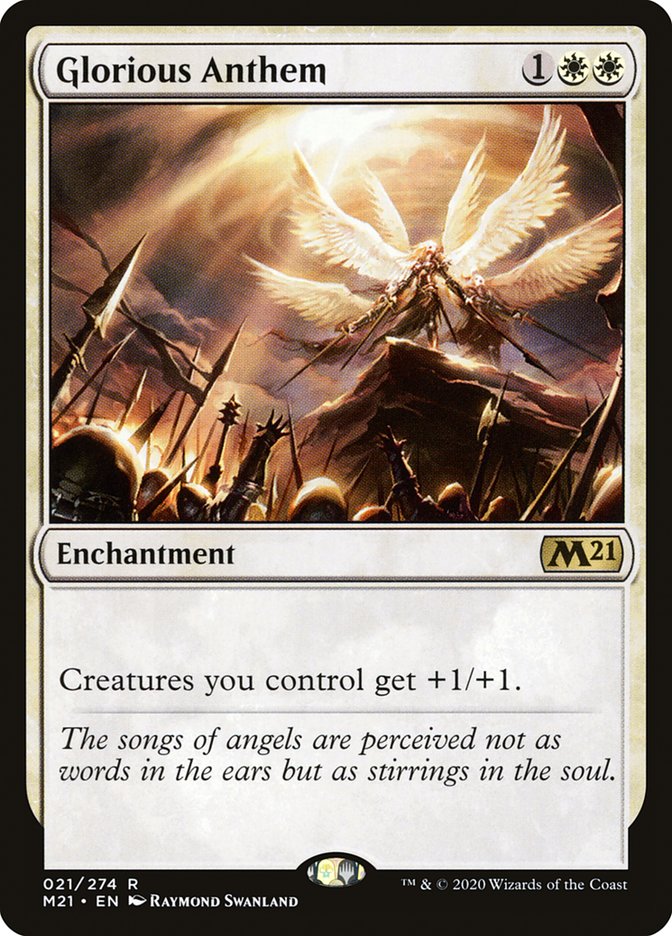
Welche Art von Fähigkeit ist die markierte Zeile?
Tasten A bis D oder Klick. Keine Zeitbegrenzung.
Kein „Wenn", kein Doppelpunkt. Die Fähigkeit ist einfach wahr, solange Glorious Anthem im Spiel ist. Statische Fähigkeiten erzeugen Dauereffekte und gehen nie auf den Stack.
Beteiligte Karten

Fähigkeits-Arten
: Diese Kreatur fügt einem Ziel deiner Wahl 1 Schadenspunkt zu.
Welche Art von Fähigkeit ist die markierte Zeile?
Tasten A bis D oder Klick. Keine Zeitbegrenzung.
„Kosten: Effekt" macht sie aktiviert. Sie hat ein Ziel und erzeugt kein Mana, also keine Mana-Fähigkeit. Aktivieren heißt: auf den Stack legen und Kosten bezahlen, der Gegner kann antworten.
602.1Activated abilities have a cost and an effect. They are written as “[Cost]: [Effect.] [Activation instructions (if any).]”
602.2To activate an ability is to put it onto the stack and pay its costs, so that it will eventually resolve and have its effect. Only an object’s controller (or its owner, if it doesn’t have a controller) can activate its activated ability unless the object specifically says otherwise. Activating an ability follows the steps listed below, in order. If, at any point during the activation of an ability, a player is unable to comply with any of those steps, the activation is illegal; the game returns to the moment before that ability started to be activated (see rule 733, “Handling Illegal Actions”). Announcements and payments can’t be altered after they’ve been made.
605.1aAn activated ability is a mana ability if it meets all of the following criteria: it doesn’t require a target (see rule 115.6), it could add mana to a player’s mana pool when it resolves, it’s not a loyalty ability (see rule 606, “Loyalty Abilities”), and its cost and effect don’t move any card to or from a library. Do not take into account replacement effects that may apply, other than self-replacement effects, when evaluating these criteria.
Beteiligte Karten

Fähigkeits-Arten
Mind Stone hat zwei Fähigkeiten: „: Erzeuge  ." und „
 , , opfere dieses Artefakt: Ziehe eine Karte." Welche davon geht auf den Stack?
Tasten A bis D oder Klick. Keine Zeitbegrenzung.
Mana-Fähigkeiten gehen nicht auf den Stack, man kann sie nicht beantworten. Die Zieh-Fähigkeit erzeugt kein Mana, also normale aktivierte Fähigkeit: Sie geht auf den Stack und kann beantwortet werden, zum Beispiel mit einem Spruch, der Mind Stone zerstört (die Fähigkeit verrechnet sich trotzdem, Thema für Level 3).
605.1aAn activated ability is a mana ability if it meets all of the following criteria: it doesn’t require a target (see rule 115.6), it could add mana to a player’s mana pool when it resolves, it’s not a loyalty ability (see rule 606, “Loyalty Abilities”), and its cost and effect don’t move any card to or from a library. Do not take into account replacement effects that may apply, other than self-replacement effects, when evaluating these criteria.
605.3bAn activated mana ability doesn’t go on the stack, so it can’t be targeted, countered, or otherwise responded to. Rather, it resolves immediately after it is activated. (See rule 405.6c.)
602.2To activate an ability is to put it onto the stack and pay its costs, so that it will eventually resolve and have its effect. Only an object’s controller (or its owner, if it doesn’t have a controller) can activate its activated ability unless the object specifically says otherwise. Activating an ability follows the steps listed below, in order. If, at any point during the activation of an ability, a player is unable to comply with any of those steps, the activation is illegal; the game returns to the moment before that ability started to be activated (see rule 733, “Handling Illegal Actions”). Announcements and payments can’t be altered after they’ve been made.
Beteiligte Karten
Fähigkeits-Arten
Aussage
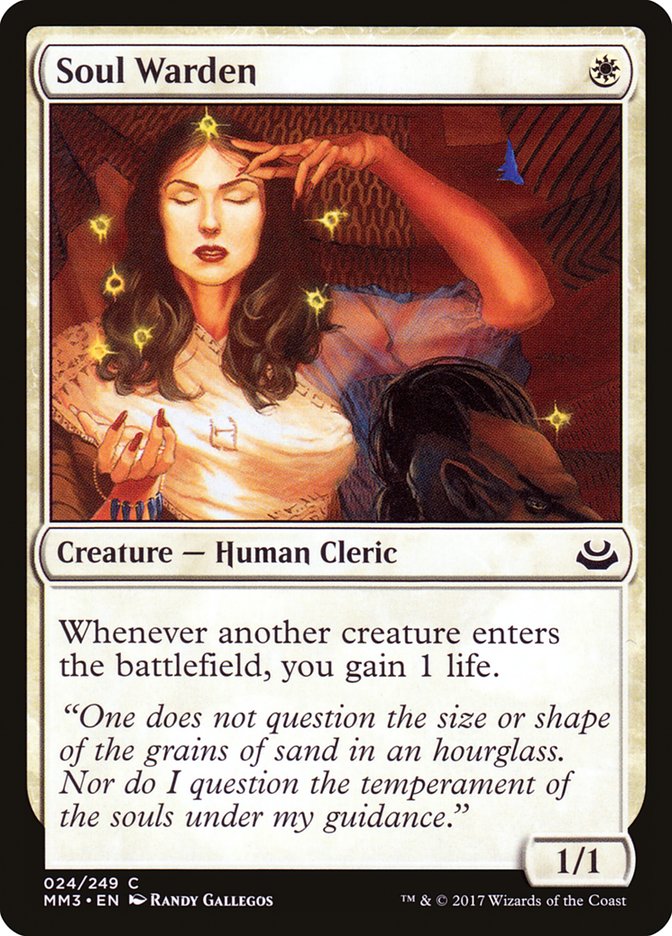
„Eine ausgelöste Fähigkeit wie die von Soul Warden muss ich aktivieren, sonst passiert nichts. "
Wähle eine Antwort — dann geht es weiter.
Ausgelöste Fähigkeiten lösen automatisch aus, sobald das Ereignis eintritt. Der Spieler, der die Quelle beim Auslösen kontrolliert hat (das muss nicht ihr Besitzer sein), legt sie auf den Stack, wenn das nächste Mal ein Spieler Priorität bekäme. Aktiviert werden nur Fähigkeiten mit Kosten und Doppelpunkt.
603.2Whenever a game event or game state matches a triggered ability’s trigger event, that ability automatically triggers. The ability doesn’t do anything at this point.
603.3Once an ability has triggered, its controller puts it on the stack as an object that’s not a card the next time a player would receive priority. See rule 117, “Timing and Priority.” The ability becomes the topmost object on the stack. It has the text of the ability that created it, and no other characteristics. It remains on the stack until it’s countered, it resolves, a rule causes it to be removed from the stack, or an effect moves it elsewhere.
603.3aA triggered ability is controlled by the player who controlled its source at the time it triggered, unless it’s a delayed triggered ability. To determine the controller of a delayed triggered ability, see rules 603.7d–f.
Zugstruktur
In welcher Reihenfolge laufen die fünf Phasen eines Zugs ab?
Tasten A bis D oder Klick. Keine Zeitbegrenzung.
Fünf Phasen in fester Reihenfolge, jede findet in jedem Zug statt, auch wenn nichts passiert. Anfangs-, Kampf- und Endphase sind in Segmente unterteilt.
500.1A turn consists of five phases, in this order: beginning, precombat main, combat, postcombat main, and ending. Each of these phases takes place every turn, even if nothing happens during the phase. The beginning, combat, and ending phases are further broken down into steps, which proceed in order.
Zugstruktur
Aus welchen Segmenten besteht die Anfangsphase, in dieser Reihenfolge?
Tasten A bis D oder Klick. Keine Zeitbegrenzung.
Enttappen (keine Priorität), dann Versorgen (hier lösen die „zu Beginn deines Versorgungssegments"-Fähigkeiten aus), dann Ziehen.
501.1The beginning phase consists of three steps, in this order: untap, upkeep, and draw.
502.4No player receives priority during the untap step, so no spells can be cast or resolve and no abilities can be activated or resolve. Any ability that triggers during this step will be held until the next time a player would receive priority, which is usually during the upkeep step. (See rule 503, “Upkeep Step.”)
Zugstruktur
Aussage
„Im Enttappsegment kann ich noch schnell einen Spontanzauber wirken, bevor der Gegner seine Kreaturen enttappt. "
Wähle eine Antwort — dann geht es weiter.
Im Enttappsegment bekommt kein Spieler Priorität. Es können keine Sprüche gewirkt und keine Fähigkeiten aktiviert werden. Wer „in der Enttapp-Phase" etwas tun will, tut es im Endsegment des vorherigen Zugs.
502.4No player receives priority during the untap step, so no spells can be cast or resolve and no abilities can be activated or resolve. Any ability that triggers during this step will be held until the next time a player would receive priority, which is usually during the upkeep step. (See rule 503, “Upkeep Step.”)
Zugstruktur
Zwei-Spieler-Partie. Der Spieler, der beginnt, überspringt in seinem ersten Zug …
Tasten A bis D oder Klick. Keine Zeitbegrenzung.
Wer anfängt, überspringt das Ziehsegment seines ersten Zugs. Das gleicht den Vorteil des ersten Zugs aus und gilt in Partien mit zwei Spielern sowie in Teamformaten wie Two-Headed Giant, nicht im freien Mehrspieler-Spiel.
Zugstruktur
Welche fünf Segmente hat die Kampfphase, in dieser Reihenfolge?
Tasten A bis D oder Klick. Keine Zeitbegrenzung.
Fünf Segmente in fester Reihenfolge. Blocker- und Schadenssegment werden übersprungen, wenn keine Kreatur angreift. In jedem Segment bekommen die Spieler Priorität, deshalb kann man zwischen Angreifern und Blockern noch handeln.
506.1The combat phase has five steps, which proceed in order: beginning of combat, declare attackers, declare blockers, combat damage, and end of combat. The declare blockers and combat damage steps are skipped if no creatures are declared as attackers or put onto the battlefield attacking (see rule 508.8). There are two combat damage steps if any attacking or blocking creature has first strike (see rule 702.7) or double strike (see rule 702.4).
Zugstruktur
Aus welchen Segmenten besteht die Endphase, und was passiert im Aufräumsegment?
Tasten A bis D oder Klick. Keine Zeitbegrenzung.
Zwei Segmente, in dieser Reihenfolge. Im Endsegment lösen „zu Beginn des Endsegments"-Fähigkeiten aus und die Spieler bekommen Priorität. Im Aufräumsegment passiert dann der Rest ohne Stack: Abwerfen bis auf 7, Schaden weg, Zug-Effekte enden. Priorität gibt es hier normalerweise nicht.
512.1The ending phase consists of two steps: end and cleanup.
513.1The end step has no turn-based actions. Once it begins, the active player gets priority. (See rule 117, “Timing and Priority.”)
514.1First, if the active player’s hand contains more cards than their maximum hand size (normally seven), they discard enough cards to reduce their hand size to that number. This turn-based action doesn’t use the stack.
514.2Second, the following actions happen simultaneously: all damage marked on permanents (including phased-out permanents) is removed and all “until end of turn” and “this turn” effects end. This turn-based action doesn’t use the stack.
Beteiligte Karten
Kartentypen
Im Endsegment deines Gegners hast du Priorität und zwei Länder offen. Darfst du jetzt Grizzly Bears wirken?
Tasten A bis D oder Klick. Keine Zeitbegrenzung.
Kreaturen folgen dem gleichen Timing wie Hexereien: eigene Hauptphase (1 oder 2), Priorität, leerer Stack. Ausnahme ist nur das Schlüsselwort Aufblitzen.
Kartentypen
Welche Kartentypen darfst du nur in deiner Hauptphase bei leerem Stack wirken?
Tasten A bis D oder Klick. Keine Zeitbegrenzung.
Die Regel ist allgemein formuliert: Spontanzauber jederzeit mit Priorität, alle anderen Zauber nur in der eigenen Hauptphase bei leerem Stack. Das betrifft Kreaturen, Hexereien, Verzauberungen, Artefakte, Planeswalker und Schlachten (Battles).
117.1aA player may cast an instant spell any time they have priority. A player may cast a noninstant spell during their main phase any time they have priority and the stack is empty.
307.1A player who has priority may cast a sorcery card from their hand during a main phase of their turn when the stack is empty. Casting a sorcery as a spell uses the stack. (See rule 601, “Casting Spells.”)
Kartentypen
Du spielst ein Land. Was davon stimmt?
Tasten A bis D oder Klick. Keine Zeitbegrenzung.
Ein Land spielen ist eine Sonderaktion: kein Zauber, kein Stack, kann nicht beantwortet werden. Normalerweise einmal pro Zug, in der eigenen Hauptphase bei leerem Stack und Priorität.
305.1A player who has priority may play a land card from their hand during a main phase of their turn when the stack is empty. Playing a land is a special action; it doesn’t use the stack (see rule 116). Rather, the player simply puts the land onto the battlefield. Since the land doesn’t go on the stack, it is never a spell, and players can’t respond to it with instants or activated abilities.
305.2A player can normally play one land during their turn; however, continuous effects may increase this number.
116.2aPlaying a land is a special action. To play a land, a player puts that land onto the battlefield from the zone it was in (usually that player’s hand). By default, a player can take this action only once during each of their turns. A player can take this action any time they have priority and the stack is empty during a main phase of their turn. See rule 305, “Lands.”
Beteiligte Karten

Kartentypen
Aussage
„Pacifism ist ein Zauber mit Ziel. Stirbt die Kreatur, auf die ich es wirke, als Antwort darauf, geht Pacifism beim Verrechnen auf den Friedhof. "
Wähle eine Antwort — dann geht es weiter.
Ein Aura-Zauber hat beim Wirken immer ein Ziel, das die „Verzaubert …"-Fähigkeit vorgibt. Beim Verrechnen wird das Ziel geprüft. Ist es weg, ist das einzige Ziel illegal, der Zauber wird nicht verrechnet und geht auf den Friedhof.
303.4aAn Aura spell requires a target, which is defined by its enchant ability.
608.2bIf the spell or ability specifies targets, it checks whether the targets are still legal. A target that’s no longer in the zone it was in when it was targeted is illegal. Other changes to the game state may cause a target to no longer be legal; for example, its characteristics may have changed or an effect may have changed the text of the spell. If the source of an ability has left the zone it was in, its last known information is used during this process. If all its targets, for every instance of the word “target,” are now illegal, the spell or ability doesn’t resolve. It’s removed from the stack and, if it’s a spell, put into its owner’s graveyard. Otherwise, the spell or ability will resolve normally. Illegal targets, if any, won’t be affected by parts of a resolving spell’s effect for which they’re illegal. Other parts of the effect for which those targets are not illegal may still affect them. If the spell or ability creates any continuous effects that affect game rules (see rule 613.11), those effects don’t apply to illegal targets. If part of the effect requires information about an illegal target, it fails to determine any such information. Any part of the effect that requires that information won’t happen.