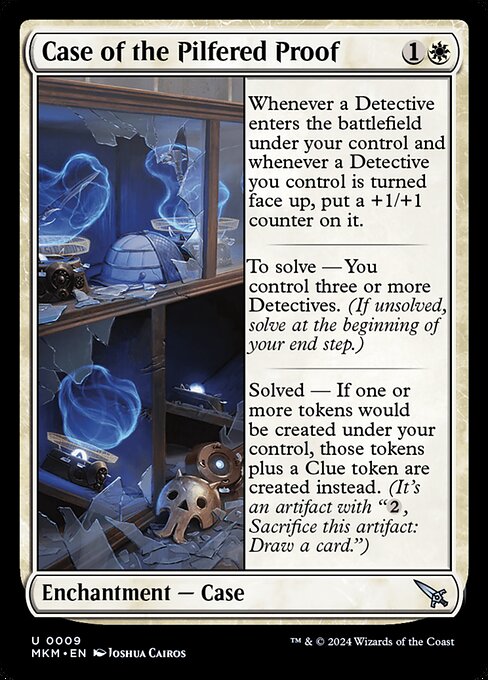
Case of the Pilfered Proof
Enchantment — Case
Rarity
Uncommon
Mana Cost


Price · Cardmarket trend
€0.15 Foil €0.14
Artist
Joshua Cairos
Cardmarket trend via Scryfall, as of 10/28/2026. May differ from the actual price.
Oracle Text
Whenever a Detective you control enters or is turned face up, put a +1/+1 counter on it. To solve — You control three or more Detectives. (If unsolved, solve at the beginning of your end step.) Solved — If one or more tokens would be created under your control, those tokens plus a Clue token are created instead. (It's an artifact with " , Sacrifice this token: Draw a card.")
Community
👥
1 player has this card
🔄
1 offers it for trade
Want to trade this card?
Sign up for freeRules for this card
Rulings (14)
-
Wizards of the CoastYou can't sacrifice a Clue to pay multiple costs. For example, you can't sacrifice a Clue token to activate its own ability and also to activate Alquist Proft, Master Sleuth's ability.
-
Wizards of the CoastThe meaning of "solved" differs based on what type of ability follows it. "Solved — [activated ability]" means "[Activated ability]. Activate only if this Case is solved." Activated abilities contain a colon. They're generally written "[Cost]: [Effect]."
-
Wizards of the CoastBeing solved is not part of a permanent's copiable values. A permanent that becomes a copy of a solved Case is not solved. A solved Case that somehow becomes a copy of a different Case stays solved.
-
Wizards of the Coast"Solved — [static ability]" means "As long as this Case is solved, [static ability]." Static abilities are written as statements, such as "Creatures you control get +1/+1" or "Instant and sorcery spells you cast cost less to cast."
-
Wizards of the CoastSome spells and abilities that investigate may require targets. If each target chosen is an illegal target as that spell or ability tries to resolve, it won't resolve. You won't create any Clue tokens.
-
Wizards of the CoastCases don't lose their other abilities when they become solved.
-
Wizards of the CoastSome abilities trigger "whenever you sacrifice a Clue". Those abilities trigger whenever you sacrifice a Clue for any reason, not just to activate a Clue's activated ability.
-
Wizards of the Coast"To Solve — [condition]" means "At the beginning of your end step, if [condition] and this Case is not solved, it becomes solved."
-
Wizards of the CoastOnce a Case becomes solved, it stays solved until it leaves the battlefield.
-
Wizards of the CoastEach Case has two special keyword abilities: to solve and solved.
-
Wizards of the CoastClue is an artifact type. Even though it appears on some cards with other permanent types, it's never a creature type, a land type, or anything but an artifact type.
-
Wizards of the Coast"Solved — [Triggered ability]" means "[Triggered ability]. This ability triggers only if this Case is solved." Triggered abilities use the word "when," "whenever," or "at." They're often written as "[Trigger condition], [effect]."
-
Wizards of the CoastIf an effect refers to a Clue, it means any Clue artifact, not just a Clue artifact token. For example, you can sacrifice Wrench to pay for Alquist Proft, Master Sleuth's activated ability.
-
Wizards of the Coast"To solve" abilities will check for their condition twice: once when the ability would trigger, and once when it resolves. If the condition isn't true at the beginning of your end step, the ability won't trigger at all. If the condition isn't true when the ability resolves, the Case won't become solved.