Level 6 · Judge Material
Cards involved

Copies
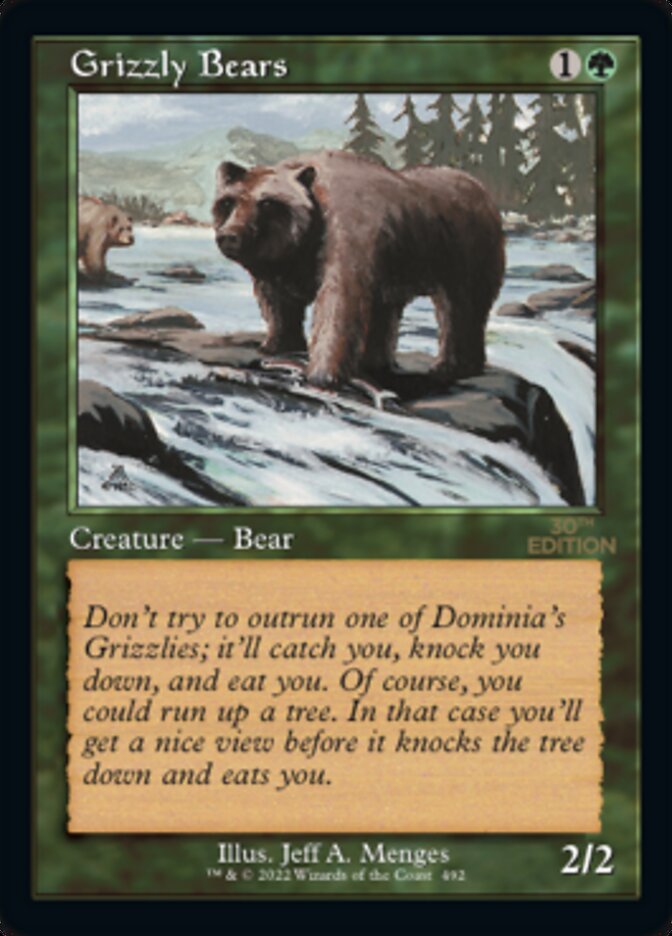
Your first Clone is on the battlefield as a copy of Grizzly Bears. Now you cast a second Clone and choose the first Clone as what it copies. What does the second Clone enter as?
Keys A to D or click. No time limit.
A copy effect changes the object’s copiable values (707.3). For every later copy, the first Clone “is” a Grizzly Bears, including name, mana cost and abilities (here: none). None of Clone’s text is left over; it’s no longer part of the copiable values. Exception: effects that explicitly grant an ability (“except it has this ability”) make that ability part of the copiable values (707.9a).
707.3The copy’s copiable values become the copied information, as modified by the copy’s status (see rule 110.5). Objects that copy the object will use the new copiable values.
707.2When copying an object, the copy acquires the copiable values of the original object’s characteristics and, for an object on the stack, choices made when casting or activating it (mode, targets, the value of X, whether it was kicked, how it will affect multiple targets, and so on). The copiable values are the values derived from the text printed on the object (that text being name, mana cost, color indicator, card type, subtype, supertype, rules text, power, toughness, and/or loyalty), as modified by other copy effects, by its face-down status, and by “as . . . enters” and “as . . . is turned face up” abilities that set power and toughness (and may also set additional characteristics). Other effects (including type-changing and text-changing effects), status, counters, and stickers are not copied.
707.9aSome copy effects cause the copy to gain an ability as part of the copying process. This ability becomes part of the copiable values for the copy, along with any other abilities that were copied.
Cards involved

Copies
At the beginning of your combat, Helm of the Host creates a token that’s a copy of the equipped legendary creature, “except the token isn’t legendary,” and the token gains haste. Later your Clone enters as a copy of that token. Is the Clone legendary, and does it have haste?
Keys A to D or click. No time limit.
When a copy effect modifies a characteristic (“except it isn’t legendary”), the modified value becomes part of the copiable values (707.9b). So the next copier takes over “not legendary.” “That token gains haste” isn’t part of the copy process but a separate effect on that token, and effects aren’t copied (707.2). In practice: Clone and token may sit side by side; the legend rule (704.5j) doesn’t apply.
707.9bSome copy effects modify a characteristic as part of the copying process. The final set of values for that characteristic becomes part of the copiable values of the copy.
707.2When copying an object, the copy acquires the copiable values of the original object’s characteristics and, for an object on the stack, choices made when casting or activating it (mode, targets, the value of X, whether it was kicked, how it will affect multiple targets, and so on). The copiable values are the values derived from the text printed on the object (that text being name, mana cost, color indicator, card type, subtype, supertype, rules text, power, toughness, and/or loyalty), as modified by other copy effects, by its face-down status, and by “as . . . enters” and “as . . . is turned face up” abilities that set power and toughness (and may also set additional characteristics). Other effects (including type-changing and text-changing effects), status, counters, and stickers are not copied.
704.5jIf two or more legendary permanents with the same name are controlled by the same player, that player chooses one of them, and the rest are put into their owners’ graveyards. This is called the “legend rule.”
Cards involved

Copies
You cast Grizzly Bears and copy the creature spell with Double Major. What happens to the copy as it resolves?
Keys A to D or click. No time limit.
A copy of a permanent spell becomes a token as it resolves (111.13, 707.10f, 608.3f). The token has the spell’s characteristics, stays permanently and behaves like any other token: if it leaves the battlefield, it ceases to exist the next time state-based actions are checked (704.5d). Because it isn’t “created,” Doubling Season or Anointed Procession won’t double it.
111.13A copy of a permanent spell becomes a token as it resolves. The token has the characteristics of the spell that became that token. The token is not “created” for the purposes of any replacement effects or triggered abilities that refer to creating a token.
707.10fSome effects copy a permanent spell. As that copy resolves, it ceases being a copy of a spell and becomes a token permanent. (See rule 608.3f.)
608.3fIf the object that’s resolving is a copy of a permanent spell, it will become a token permanent as it is put onto the battlefield in any of the steps above. A token put onto the battlefield this way is no longer a copy of a spell and is not “created” for the purposes of any rules or effects that refer to creating a token.
704.5dIf a token is in a zone other than the battlefield, it ceases to exist.
Cards involved

Copies
Your Clone enters as a copy of Wall of Omens (“When this creature enters, draw a card”). Do you draw a card?
Keys A to D or click. No time limit.
“Enters as a copy” means the copy effect already applies as it enters (707.5). That’s why “enter tapped” or “enters with counters” of the original apply too, and enters-the-battlefield abilities trigger (603.6a). It’s different for effects that turn a permanent already on the battlefield into a copy (Cytoshape, Unstable Shapeshifter): nothing enters, so no trigger (707.4). The old Wall doesn’t trigger again; it didn’t enter.
707.5An object that enters the battlefield “as a copy” or “that’s a copy” of another object becomes a copy as it enters the battlefield. It doesn’t enter the battlefield, and then become a copy of that permanent. If the text that’s being copied includes any abilities that replace the enters-the-battlefield event (such as “enters with” or “as [this] enters” abilities), those abilities will take effect. Also, any enters-the-battlefield triggered abilities of the copy will have a chance to trigger.
603.6aEnters-the-battlefield abilities trigger when a permanent enters the battlefield. These are written, “When [this object] enters, . . . “ or “Whenever a [type] enters, . . .” Each time an event puts one or more permanents onto the battlefield, all permanents on the battlefield (including the newcomers) are checked for any enters-the-battlefield triggers that match the event.
707.4Some effects cause a permanent that’s copying a permanent to copy a different object while remaining on the battlefield. The change doesn’t cause enters-the-battlefield or leaves-the-battlefield abilities to trigger. This also doesn’t change any noncopy effects presently affecting the permanent.
Cards involved
Copies
Statement
„If the copy of a spell created by Twincast is countered, it ends up as a card in its owner’s graveyard. "
Pick an answer — then move on.
A spell copy exists only on the stack. When it leaves, whether by resolving, being countered or fizzling, it ceases to exist the next time state-based actions are checked (707.10a, 704.5e). There is no card that could go anywhere. The copy was never cast either (707.10); it was created.
707.10aIf a copy of a spell is in a zone other than the stack, it ceases to exist. If a copy of a card is in any zone other than the stack or the battlefield, it ceases to exist. These are state-based actions. See rule 704.
704.5eIf a copy of a spell is in a zone other than the stack, it ceases to exist. If a copy of a card is in any zone other than the stack or the battlefield, it ceases to exist.
707.10To copy a spell, activated ability, or triggered ability means to put a copy of it onto the stack; a copy of a spell isn’t cast and a copy of an activated ability isn’t activated. A copy of a spell or ability copies both the characteristics of the spell or ability and all decisions made for it, including modes, targets, the value of X, and additional or alternative costs. (See rule 601, “Casting Spells.”) Choices that are normally made on resolution are not copied. If an effect of the copy refers to objects used to pay its costs, it uses the objects used to pay the costs of the original spell or ability. A copy of a spell is owned by the player under whose control it was put on the stack. A copy of a spell or ability is controlled by the player under whose control it was put on the stack. A copy of a spell is itself a spell, even though it has no spell card associated with it. A copy of an ability is itself an ability.
Cards involved


Double-Faced Cards
Your Delver of Secrets has transformed into Insectile Aberration. The back face has no printed mana cost. What is the Aberration’s mana value now, say for Fatal Push (“Destroy target creature if it has mana value 2 or less”)?
Keys A to D or click. No time limit.
While a nonmodal double-faced card has its back face up, it has only the back face’s characteristics, but its mana value is calculated from the front face’s mana cost (712.8e, 202.3b). Insectile Aberration has mana value 1. Special case: if a Clone copies the back face, the copy has mana value 0, because it has no front face to derive anything from (712.8e).
712.8eWhile a nonmodal double-faced permanent has its back face up, it has only the characteristics of its back face. However, its mana value is calculated using the mana cost of its front face. If a permanent is copying the back face of a nonmodal double-faced permanent (even if the object representing that copy is itself a double-faced permanent), the mana value of that permanent is 0. See rule 202.3b.
202.3bThe mana value of the back face of a nonmodal double-faced permanent or spell’s back face is calculated as though it had the mana cost of its front face. If a permanent or spell is a copy of the back face of a nonmodal double-faced object (even if the card representing that copy is itself a double-faced card), the mana value of the copy is 0.
Cards involved

Double-Faced Cards
Jwari Disruption // Jwari Ruins is a modal double-faced card: an instant on the front, a land on the back. You resolve “Search your library for a land card.” May you take Jwari Disruption?
Keys A to D or click. No time limit.
Outside the battlefield and the stack only the front face counts (712.8a). In library, hand and graveyard Jwari Disruption is an instant, not a land card. From your hand you may still play it as a land: when playing it you choose the land face (712.12), and it uses your land drop. For Commander color identity, however, the back face does count (903.4d).
712.8aWhile a double-faced card is outside the game or in a zone other than the battlefield or stack, it has only the characteristics of its front face.
712.12A player playing a modal double-faced card or a copy of a modal double-faced card as a land chooses one of its faces that’s a land before putting it onto the battlefield. It enters the battlefield with that face up. See rule 305, “Lands.”
903.4dThe back face of a double-faced card (see rule 712) is included when determining a card’s color identity. This is an exception to rule 712.8a.
Cards involved

Double-Faced Cards
You want to save your Insectile Aberration (a transformed Delver of Secrets) from removal. You cast Cloudshift: exile it and return it immediately. How does it come back?
Keys A to D or click. No time limit.
When it changes zones, the card becomes a new object with no memory of its past (400.7). In exile it has only its front face (712.8a), and when it comes back from anywhere other than the stack it enters front face up (712.14), unless an effect explicitly says “transformed” (712.14a). Your 3/2 flier is a 1/1 Delver again and has to transform anew. The same goes for the graveyard: what’s there is Delver of Secrets, not an Aberration.
712.14A double-faced card put onto the battlefield from a zone other than the stack enters the battlefield with its front face up by default.
712.8aWhile a double-faced card is outside the game or in a zone other than the battlefield or stack, it has only the characteristics of its front face.
400.7An object that moves from one zone to another becomes a new object with no memory of, or relation to, its previous existence. This rule has the following exceptions.
712.14aIf a spell or ability puts a double-faced card onto the battlefield “transformed” or “converted,” it enters the battlefield with its back face up. If a player is instructed to put a card that isn’t a double-faced card onto the battlefield transformed or converted, that card stays in its current zone.
Cards involved
Double-Faced Cards
Your Clone enters as a copy of your opponent’s Insectile Aberration (the back face of Delver of Secrets). What is your Clone?
Keys A to D or click. No time limit.
What gets copied is the face that’s currently up (707.8). Clone is an Insectile Aberration, but: it has no front face to derive a mana value from, so its mana value is 0 (712.8e), and as a regular card it can’t transform (712.9). Token copies are different: if an effect creates a token that’s a copy of a double-faced card, the token gets both faces and can transform (707.8a, see the trainer).
707.8When copying a melded permanent or other double-faced permanent, use the copiable values of the face that’s currently up to determine the characteristics of the copy. See rule 712, “Double-Faced Cards.”
712.8eWhile a nonmodal double-faced permanent has its back face up, it has only the characteristics of its back face. However, its mana value is calculated using the mana cost of its front face. If a permanent is copying the back face of a nonmodal double-faced permanent (even if the object representing that copy is itself a double-faced permanent), the mana value of that permanent is 0. See rule 202.3b.
712.9Only permanents represented by double-faced tokens and double-faced cards that are not meld cards can transform or convert. (See rule 701.27, “Transform,” and rule 701.28, “Convert.”) If a spell or ability instructs a player to transform or convert any permanent that isn’t represented by a double-faced token or a double-faced card, nothing happens.
707.8aIf an effect creates a token that is a copy of a double-faced permanent or a double-faced card not on the battlefield, the resulting token is a double-faced token that has both a front face and a back face. The characteristics of each face are determined by the copiable values of the same face of the permanent or card it is a copy of, as modified by any other copy effects that apply to that object. If the token is a copy of a double-faced permanent with its back face up, the token enters the battlefield with its back face up. This rule does not apply to tokens that are created with their own set of characteristics and enter the battlefield as a copy of a double-faced object due to a replacement effect.
Cards involved

Double-Faced Cards
Statement
„Your Delver of Secrets has +3/+3 from Giant Growth. If an effect transforms it later this turn, it loses the bonus because it becomes a new object. "
Pick an answer — then move on.
A permanent that transforms stays the same object (712.18): Giant Growth keeps applying, counters, Auras and Equipment stay, it gets no new summoning sickness and doesn’t trigger “enters the battlefield.” Transforming is also not the same action as turning face up or face down (701.27b). A new object is created only by a zone change (400.7), for example with Cloudshift.
712.18When a double-faced permanent transforms or converts, it doesn’t become a new object. Any effects that applied to that permanent will continue to apply to it.
400.7An object that moves from one zone to another becomes a new object with no memory of, or relation to, its previous existence. This rule has the following exceptions.
701.27bAlthough transforming a permanent uses the same physical action as turning a permanent face up or face down, they are different game actions. Abilities that trigger when a permanent is turned face down won’t trigger when that permanent transforms, and so on.
Cards involved

Commander
Tatsumasa, the Dragon’s Fang is a colorless artifact with the text “ , Exile Tatsumasa: Create a 5/5 blue Dragon Spirit creature token with flying.” May you play it in a deck with a mono-white commander?
Keys A to D or click. No time limit.
Color identity = the colors of all mana symbols in mana cost and rules text plus color indicator and color-defining abilities (903.4). Words like “blue” don’t count, nor does reminder text (903.4c). Counterexample Bosh, Iron Golem: a colorless artifact with 
 in its text, identity red. Whether the token is blue in the game doesn’t matter; color identity is established before the game begins (903.4a) and decides deck legality (903.5c).
903.4The Commander variant uses color identity to determine what cards can be in a deck with a certain commander. The color identity of a card is the color or colors of any mana symbols in that card’s mana cost or rules text, plus any colors defined by its characteristic-defining abilities (see rule 604.3) or color indicator (see rule 204).
903.4cReminder text is ignored when determining a card’s color identity. See rule 207.2.
903.5cA card can be included in a Commander deck only if every color in its color identity is also found in the color identity of the deck’s commander.
903.4aColor identity is established before the game begins. If a rule or effect refers to the color identity of an object in the game represented by a card, it uses the color identity established for that card as the game began.
Cards involved

Commander
Westvale Abbey is a land with no colored mana symbols in its text. Its back face, Ormendahl, Profane Prince, has a black color indicator. May the land go into a deck with a mono-white commander?
Keys A to D or click. No time limit.
Normally a double-faced card outside the battlefield and the stack has only its front face (712.8a). Color identity is the explicit exception: both faces count (903.4d), including the color indicator (903.4). Ormendahl makes the land black, so it’s only allowed in decks whose commander has black in its identity (903.5c). The same applies to Adventure halves (903.4e).
903.4dThe back face of a double-faced card (see rule 712) is included when determining a card’s color identity. This is an exception to rule 712.8a.
903.4The Commander variant uses color identity to determine what cards can be in a deck with a certain commander. The color identity of a card is the color or colors of any mana symbols in that card’s mana cost or rules text, plus any colors defined by its characteristic-defining abilities (see rule 604.3) or color indicator (see rule 204).
903.5cA card can be included in a Commander deck only if every color in its color identity is also found in the color identity of the deck’s commander.
712.8aWhile a double-faced card is outside the game or in a zone other than the battlefield or stack, it has only the characteristics of its front face.
Cards involved


Commander
You control Blood Artist. Your opponent kills your commander with Doom Blade, and you move it to the command zone. Does Blood Artist (“Whenever Blood Artist or another creature dies”) trigger?
Keys A to D or click. No time limit.
Since the 2020 rules change, moving from graveyard or exile to the command zone is a state-based action (903.9a, 704.6d): the commander really goes to the graveyard, “dies” abilities like Blood Artist trigger, and afterwards you may move it. Hand and library work differently, via a replacement effect (903.9b): Unsummon on your commander puts it straight into the command zone; it was never in your hand.
903.9aIf a commander is in a graveyard or in exile and that object was put into that zone since the last time state-based actions were checked, its owner may put it into the command zone. This is a state-based action. See rule 704.
704.6dIn a Commander game, if a commander is in a graveyard or in exile and that object was put into that zone since the last time state-based actions were checked, its owner may put it into the command zone. See rule 903, “Commander.”
903.9bIf a commander would be put into its owner’s hand or library from anywhere, its owner may put it into the command zone instead. This replacement effect may apply more than once to the same event. This is an exception to rule 614.5.
Commander
Statement
„Your opponent has dealt you 11 combat damage with partner commander A and 10 combat damage with partner commander B. You have lost. "
Pick an answer — then move on.
The 21-damage rule counts per commander: a player loses once the same commander has dealt them 21 or more combat damage over the course of the game (903.10a, 704.6c). Two partners are tracked separately; 11 and 10 aren’t enough. And a copy of the commander (Clone, Body Double) isn’t a commander, so its damage doesn’t count at all (903.3).
903.10aA player who’s been dealt 21 or more combat damage by the same commander over the course of the game loses the game. (This is a state-based action. See rule 704.)
704.6cIn a Commander game, a player who’s been dealt 21 or more combat damage by the same commander over the course of the game loses the game. See rule 903, “Commander.”
903.3Each deck has a legendary card designated as its commander. That card must be either (a) a creature card, (b) a Vehicle card, or (c) a Spacecraft card with one or more power/toughness boxes. This designation is not a characteristic of the object represented by the card; rather, it is an attribute of the card itself. The card retains this designation even when it changes zones.
Commander
Four-player Commander game. You don’t like your opening hand and take a mulligan. How many cards do you draw, and how many do you put on the bottom of your library?
Keys A to D or click. No time limit.
London mulligan: you shuffle, draw seven again and put as many cards on the bottom as mulligans you’ve taken (103.5). In multiplayer games the first mulligan doesn’t count (103.5c), so it’s free; the second then costs one card, the third two. Careful: this hinges on “multiplayer,” not on “Commander.” In a two-player Commander game even the first mulligan costs a card, unless the tournament format says otherwise.
103.5Each player draws a number of cards equal to their starting hand size, which is normally seven. (Some effects can modify a player’s starting hand size.) A player who is dissatisfied with their initial hand may take a mulligan. First, the starting player declares whether they will take a mulligan. Then each other player in turn order does the same. Once each player has made a declaration, all players who decided to take mulligans do so at the same time. To take a mulligan, a player shuffles the cards in their hand back into their library, draws a new hand of cards equal to their starting hand size, then puts a number of those cards equal to the number of times that player has taken a mulligan on the bottom of their library in any order. Once a player chooses not to take a mulligan, the remaining cards become that player’s opening hand, and that player may not take any further mulligans. This process is then repeated until no player takes a mulligan. A player can take mulligans until their opening hand would be zero cards, after which they may not take further mulligans.
103.5cIn a multiplayer game and in any Brawl game, the first mulligan a player takes doesn’t count toward the number of cards that player will put on the bottom of their library or the number of mulligans that player may take. Subsequent mulligans are counted toward these numbers as normal.
Cards involved

State-Based Actions
Your library is empty, and you don’t control a Laboratory Maniac. You’re resolving a spell that says “Draw two cards, then you gain 5 life.” When do you lose the game?
Keys A to D or click. No time limit.
A player who tries to draw from an empty library simply draws nothing (121.4). You lose only when the game checks state-based actions: right before a player would receive priority, never in the middle of a resolution (704.3, 704.4, 704.5b). Laboratory Maniac fits exactly into that window: its replacement effect turns the draw attempt into a win before the check ever happens.
704.5bIf a player attempted to draw a card from a library with no cards in it since the last time state-based actions were checked, that player loses the game.
121.4A player who attempts to draw a card from a library with no cards in it loses the game the next time a player would receive priority. (This is a state-based action. See rule 704.)
704.3Whenever a player would get priority (see rule 117, “Timing and Priority”), the game checks for any of the listed conditions for state-based actions, then performs all applicable state-based actions simultaneously as a single event. If any state-based actions are performed as a result of a check, the check is repeated; otherwise all triggered abilities that are waiting to be put on the stack are put on the stack, then the check is repeated. Once no more state-based actions have been performed as the result of a check and no triggered abilities are waiting to be put on the stack, the appropriate player gets priority. This process also occurs during the cleanup step (see rule 514), except that if no state-based actions are performed as the result of the step’s first check and no triggered abilities are waiting to be put on the stack, then no player gets priority and the step ends.
704.4Unlike triggered abilities, state-based actions pay no attention to what happens during the resolution of a spell or ability.
Cards involved
State-Based Actions
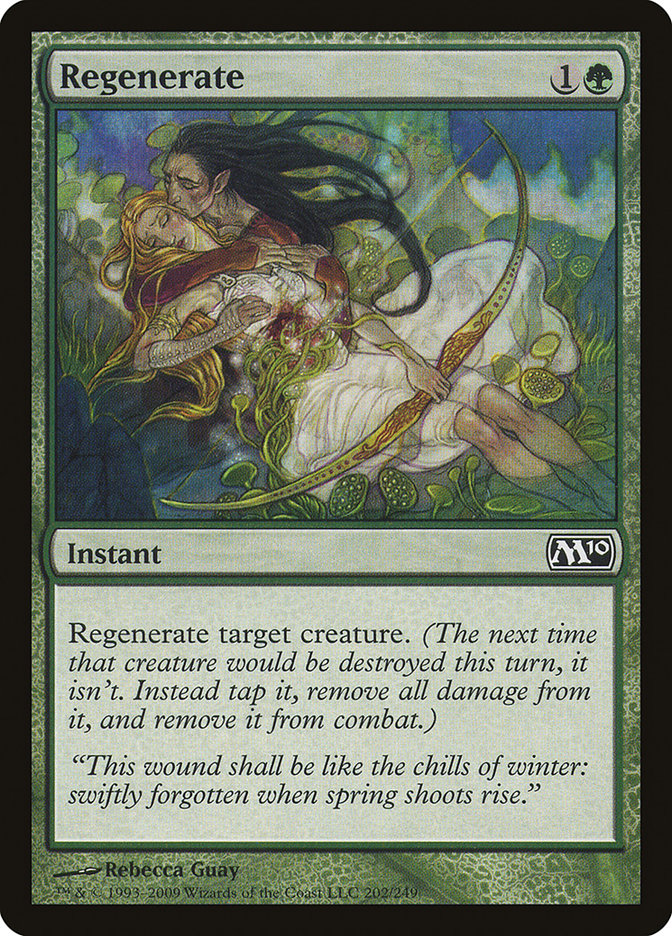
Your opponent uses an effect to put two -1/-1 counters on your Grizzly Bears (2/2). You have Regenerate and mana open. Can you save the Bears?
Keys A to D or click. No time limit.
State-based actions distinguish three cases: toughness 0 or less means straight to the graveyard, no destruction (704.5f). Damage equal to toughness or damage from a deathtouch source means the creature is destroyed (704.5g, 704.5h). Regeneration only replaces destruction (701.19a); indestructible only prevents destruction. Against toughness 0 the only help is raising toughness, for example Giant Growth in response.
704.5fIf a creature has toughness 0 or less, it’s put into its owner’s graveyard. Regeneration can’t replace this event.
704.5gIf a creature has toughness greater than 0, it has damage marked on it, and the total damage marked on it is greater than or equal to its toughness, that creature has been dealt lethal damage and is destroyed. Regeneration can replace this event.
704.5hIf a creature has toughness greater than 0, and it’s been dealt damage by a source with deathtouch since the last time state-based actions were checked, that creature is destroyed. Regeneration can replace this event.
701.19aIf the effect of a resolving spell or ability regenerates a permanent, it creates a replacement effect that protects the permanent the next time it would be destroyed this turn. In this case, “Regenerate [permanent]” means “The next time [permanent] would be destroyed this turn, instead remove all damage marked on it and its controller taps it. If it’s an attacking or blocking creature, remove it from combat.”
Cards involved


State-Based Actions
Your animated Mutavault (a 2/2 until end of turn) carries Bonesplitter and is enchanted with Rancor. The turn ends and Mutavault is just a land again. What happens to the Equipment and the Aura?
Keys A to D or click. No time limit.
An Aura enchanting something illegal is put into its owner’s graveyard (704.5m, 303.4c). “Enchant creature” is no longer satisfied on a plain land. Rancor’s ability (“When this Aura is put into a graveyard from the battlefield”) returns it to your hand. An Equipment attached to an illegal permanent merely becomes unattached and stays (704.5n, 301.5c); you can equip again later.
704.5mIf an Aura is attached to an illegal object or player, or is not attached to an object or player, that Aura is put into its owner’s graveyard.
303.4cIf an Aura is enchanting an illegal object or player as defined by its enchant ability and other applicable effects, the object it was attached to no longer exists, or the player it was attached to has left the game, the Aura is put into its owner’s graveyard. (This is a state-based action. See rule 704.)
704.5nIf an Equipment or Fortification is attached to an illegal permanent or to a player, it becomes unattached from that permanent or player. It remains on the battlefield.
301.5cAn Equipment that’s also a creature can’t equip a creature unless that Equipment has reconfigure (see rule 702.151, “Reconfigure”). An Equipment that loses the subtype “Equipment” can’t equip a creature. An Equipment can’t equip itself. An Equipment that equips an illegal or nonexistent permanent becomes unattached from that permanent but remains on the battlefield. (This is a state-based action. See rule 704.) An Equipment can’t equip more than one creature. If a spell or ability would cause an Equipment to equip more than one creature, the Equipment’s controller chooses which creature it equips.
Cards involved


State-Based Actions
History of Benalia gets its third lore counter and chapter III (“Knights you control get +2/+1”) triggers. Your opponent counters the chapter ability with Stifle. What happens to the Saga?
Keys A to D or click. No time limit.
Sacrificing a Saga isn’t an ability but a state-based action (704.5s, 714.4): lore counters at least equal to the final chapter number and no chapter ability of that Saga on the stack. While chapter III is on the stack (714.2b) the Saga stays; you can still destroy or copy it. Once the trigger leaves the stack, whether resolved or countered, it’s sacrificed. Stifle can’t counter the sacrifice because it never uses the stack.
704.5sIf the number of lore counters on a Saga permanent with one or more chapter abilities is greater than or equal to its final chapter number and it isn’t the source of a chapter ability that has triggered but not yet left the stack, that Saga’s controller sacrifices it. See rule 714, “Saga Cards.”
714.4If the number of lore counters on a Saga permanent with one or more chapter abilities is greater than or equal to its final chapter number, and it isn’t the source of a chapter ability that has triggered but not yet left the stack, that Saga’s controller sacrifices it. This state-based action doesn’t use the stack.
714.2b“{rN}—[Effect]” means “When one or more lore counters are put onto this Saga, if the number of lore counters on it was less than N and became at least N, [effect].”
Cards involved
State-Based Actions
Statement
„A creature token that dies triggers “whenever a creature dies” abilities like Blood Artist, even though it ceases to exist right afterwards. "
Pick an answer — then move on.
The token really is put into the graveyard and is only removed from the game the next time state-based actions are checked (704.5d, 111.7). The zone change happens, so all “dies” abilities trigger. What doesn’t work: bringing the token back from the graveyard. If an effect tries, it stays where it is and vanishes (111.8).
704.5dIf a token is in a zone other than the battlefield, it ceases to exist.
111.7A token that’s in a zone other than the battlefield ceases to exist. This is a state-based action; see rule 704. (Note that if a token changes zones, applicable triggered abilities will trigger before the token ceases to exist.)
111.8A token that has left the battlefield can’t move to another zone or come back onto the battlefield. If such a token would change zones, it remains in its current zone instead. It ceases to exist the next time state-based actions are checked; see rule 704.