Copying Spells: Twincast
Judge Level 1A copy may choose new targets — but it was never cast. That has consequences.
Cards involved

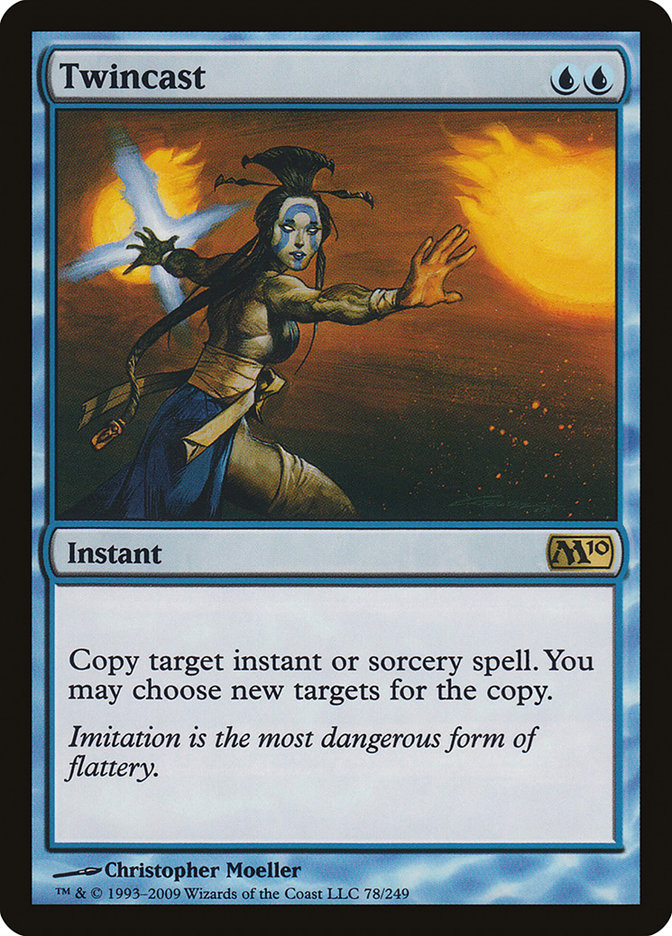

Your opponent targets you
Your opponent casts Lightning Bolt targeting you.
You copy it
In response, you cast Twincast targeting the Bolt.
601.2cThe player announces their choice of an appropriate object or player for each target the spell requires. A spell may require some targets only if an alternative or additional cost (such as a kicker cost) or a particular mode was chosen for it; otherwise, the spell is cast as though it did not require those targets. Similarly, a spell may require alternative targets only if an alternative or additional cost was chosen for it. If the spell has a variable number of targets, the player announces how many targets they will choose before they announce those targets. In some cases, the number of targets will be defined by the spell’s text. Once the number of targets the spell has is determined, that number doesn’t change, even if the information used to determine the number of targets does. The same target can’t be chosen multiple times for any one instance of the word “target” on the spell. However, if the spell uses the word “target” in multiple places, the same object or player can be chosen once for each instance of the word “target” (as long as it fits the targeting criteria). If any effects say that an object or player must be chosen as a target, the player chooses targets so that they obey the maximum possible number of such effects without violating any rules or effects that say that an object or player can’t be chosen as a target. The chosen objects and/or players each become a target of that spell. (Any abilities that trigger when those objects and/or players become the target of a spell trigger at this point; they’ll wait to be put on the stack until the spell has finished being cast.)
Twincast resolves
Twincast creates a copy of the Bolt directly on the stack — and you may choose new targets for the copy. You choose: your opponent. The copy sits above the original and resolves first.
707.10To copy a spell, activated ability, or triggered ability means to put a copy of it onto the stack; a copy of a spell isn’t cast and a copy of an activated ability isn’t activated. A copy of a spell or ability copies both the characteristics of the spell or ability and all decisions made for it, including modes, targets, the value of X, and additional or alternative costs. (See rule 601, “Casting Spells.”) Choices that are normally made on resolution are not copied. If an effect of the copy refers to objects used to pay its costs, it uses the objects used to pay the costs of the original spell or ability. A copy of a spell is owned by the player under whose control it was put on the stack. A copy of a spell or ability is controlled by the player under whose control it was put on the stack. A copy of a spell is itself a spell, even though it has no spell card associated with it. A copy of an ability is itself an ability.
707.10cSome effects copy a spell or ability and state that its controller may choose new targets for the copy. The player may leave any number of the targets unchanged, even if those targets would be illegal. If the player chooses to change some or all of the targets, the new targets must be legal. Once the player has decided what the copy’s targets will be, the copy is put onto the stack with those targets.
What happens?
Suppose you control a Guttersnipe
"Whenever you cast an instant or sorcery spell, Guttersnipe deals 2 damage to each opponent." — Does your Bolt copy trigger it?
Pick an answer to continue.
A copy on the stack is created by the copy effect — it is not cast (707.10). Careful though: abilities like magecraft explicitly say "cast or copy" and do catch copies. The difference is always in the card text.
707.10To copy a spell, activated ability, or triggered ability means to put a copy of it onto the stack; a copy of a spell isn’t cast and a copy of an activated ability isn’t activated. A copy of a spell or ability copies both the characteristics of the spell or ability and all decisions made for it, including modes, targets, the value of X, and additional or alternative costs. (See rule 601, “Casting Spells.”) Choices that are normally made on resolution are not copied. If an effect of the copy refers to objects used to pay its costs, it uses the objects used to pay the costs of the original spell or ability. A copy of a spell is owned by the player under whose control it was put on the stack. A copy of a spell or ability is controlled by the player under whose control it was put on the stack. A copy of a spell is itself a spell, even though it has no spell card associated with it. A copy of an ability is itself an ability.
The copy resolves
3 damage to your opponent.
The original resolves
The original Bolt still hits you for 3 — Twincast copied it, it didn't counter it.
Stack

Lightning Bolt
Target: you
Twincast
Copy an instant; new targets allowed
Copy: Lightning Bolt
Copy of the Bolt — target: your opponent
The stack is empty.
In short
Does a copy of a spell trigger abilities like Guttersnipe that care about casting?
Show answer Hide answer
A copy on the stack is created by the copy effect — it is not cast (707.10). Careful though: abilities like magecraft explicitly say "cast or copy" and do catch copies. The difference is always in the card text.
601.2cThe player announces their choice of an appropriate object or player for each target the spell requires. A spell may require some targets only if an alternative or additional cost (such as a kicker cost) or a particular mode was chosen for it; otherwise, the spell is cast as though it did not require those targets. Similarly, a spell may require alternative targets only if an alternative or additional cost was chosen for it. If the spell has a variable number of targets, the player announces how many targets they will choose before they announce those targets. In some cases, the number of targets will be defined by the spell’s text. Once the number of targets the spell has is determined, that number doesn’t change, even if the information used to determine the number of targets does. The same target can’t be chosen multiple times for any one instance of the word “target” on the spell. However, if the spell uses the word “target” in multiple places, the same object or player can be chosen once for each instance of the word “target” (as long as it fits the targeting criteria). If any effects say that an object or player must be chosen as a target, the player chooses targets so that they obey the maximum possible number of such effects without violating any rules or effects that say that an object or player can’t be chosen as a target. The chosen objects and/or players each become a target of that spell. (Any abilities that trigger when those objects and/or players become the target of a spell trigger at this point; they’ll wait to be put on the stack until the spell has finished being cast.)
707.10To copy a spell, activated ability, or triggered ability means to put a copy of it onto the stack; a copy of a spell isn’t cast and a copy of an activated ability isn’t activated. A copy of a spell or ability copies both the characteristics of the spell or ability and all decisions made for it, including modes, targets, the value of X, and additional or alternative costs. (See rule 601, “Casting Spells.”) Choices that are normally made on resolution are not copied. If an effect of the copy refers to objects used to pay its costs, it uses the objects used to pay the costs of the original spell or ability. A copy of a spell is owned by the player under whose control it was put on the stack. A copy of a spell or ability is controlled by the player under whose control it was put on the stack. A copy of a spell is itself a spell, even though it has no spell card associated with it. A copy of an ability is itself an ability.
707.10cSome effects copy a spell or ability and state that its controller may choose new targets for the copy. The player may leave any number of the targets unchanged, even if those targets would be illegal. If the player chooses to change some or all of the targets, the new targets must be legal. Once the player has decided what the copy’s targets will be, the copy is put onto the stack with those targets.
608.1Each time all players pass in succession, the spell or ability on top of the stack resolves. (See rule 609, “Effects.”)