Fizzling Is Not Countering
Judge Level 1A Bolt loses its target — what happens next is, rules-wise, something entirely different from a Counterspell.
Cards involved

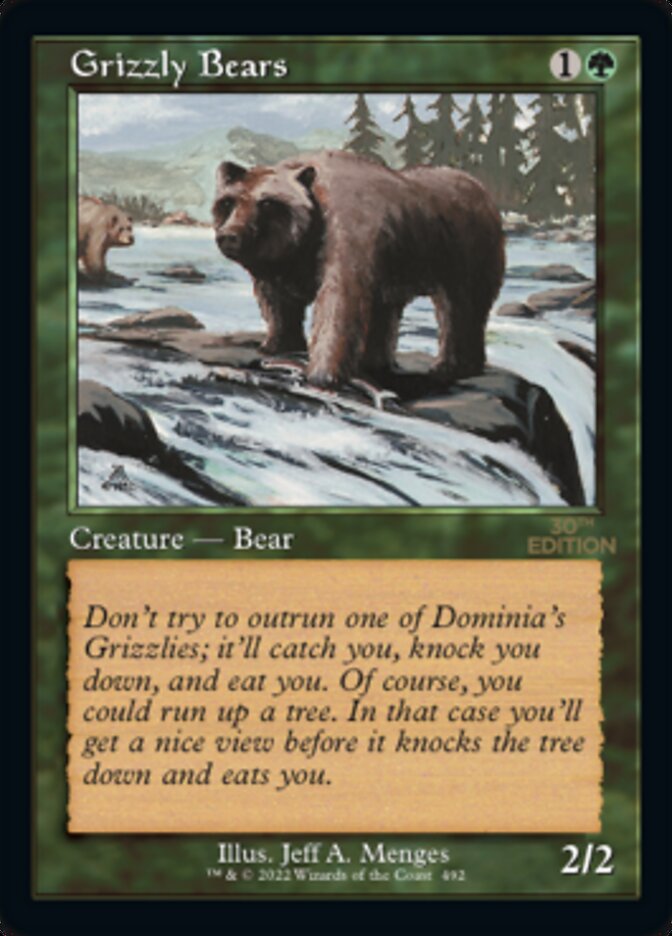
You target the Bears
Your opponent controls Grizzly Bears. You cast Lightning Bolt choosing the Bears as its target — targets are locked in when the spell is cast.
601.2cThe player announces their choice of an appropriate object or player for each target the spell requires. A spell may require some targets only if an alternative or additional cost (such as a kicker cost) or a particular mode was chosen for it; otherwise, the spell is cast as though it did not require those targets. Similarly, a spell may require alternative targets only if an alternative or additional cost was chosen for it. If the spell has a variable number of targets, the player announces how many targets they will choose before they announce those targets. In some cases, the number of targets will be defined by the spell’s text. Once the number of targets the spell has is determined, that number doesn’t change, even if the information used to determine the number of targets does. The same target can’t be chosen multiple times for any one instance of the word “target” on the spell. However, if the spell uses the word “target” in multiple places, the same object or player can be chosen once for each instance of the word “target” (as long as it fits the targeting criteria). If any effects say that an object or player must be chosen as a target, the player chooses targets so that they obey the maximum possible number of such effects without violating any rules or effects that say that an object or player can’t be chosen as a target. The chosen objects and/or players each become a target of that spell. (Any abilities that trigger when those objects and/or players become the target of a spell trigger at this point; they’ll wait to be put on the stack until the spell has finished being cast.)
Your opponent sacrifices the target
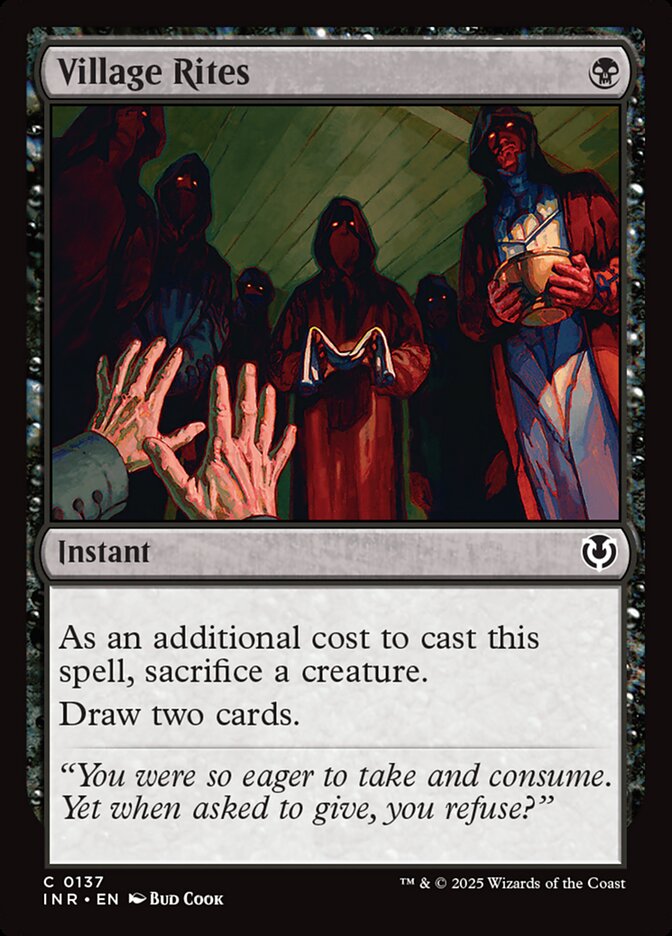
In response, your opponent casts Village Rites, sacrificing the Bears as an additional cost. Important: costs are paid while casting — the Bears are gone immediately, before anything resolves.
601.2hThe player pays the total cost. First, they pay all costs that don’t involve random elements or moving objects from the library to a public zone, in any order. Then they pay all remaining costs in any order. Partial payments are not allowed. Unpayable costs can’t be paid.
What happens?
Everyone passes.
What happens to your Bolt?
Pick an answer to continue.
As it starts to resolve, a spell first checks whether its targets are still legal. If all of its targets are illegal, it doesn't resolve and is simply removed from the stack (608.2b). It doesn't pick a new target — and it explicitly does not count as having been countered.
Village Rites resolves
Your opponent draws two cards. The Bears were doomed anyway — at least they got value out of them.
The Bolt fizzles
The Bolt checks its target: no longer there. It doesn't resolve and goes to the graveyard. Why the distinction matters: even a spell that "can't be countered" can fizzle this way.
608.2bIf the spell or ability specifies targets, it checks whether the targets are still legal. A target that’s no longer in the zone it was in when it was targeted is illegal. Other changes to the game state may cause a target to no longer be legal; for example, its characteristics may have changed or an effect may have changed the text of the spell. If the source of an ability has left the zone it was in, its last known information is used during this process. If all its targets, for every instance of the word “target,” are now illegal, the spell or ability doesn’t resolve. It’s removed from the stack and, if it’s a spell, put into its owner’s graveyard. Otherwise, the spell or ability will resolve normally. Illegal targets, if any, won’t be affected by parts of a resolving spell’s effect for which they’re illegal. Other parts of the effect for which those targets are not illegal may still affect them. If the spell or ability creates any continuous effects that affect game rules (see rule 613.11), those effects don’t apply to illegal targets. If part of the effect requires information about an illegal target, it fails to determine any such information. Any part of the effect that requires that information won’t happen.
701.6aTo counter a spell or ability means to cancel it, removing it from the stack. It doesn’t resolve and none of its effects occur. A countered spell is put into its owner’s graveyard.
Stack

Lightning Bolt
Target: the Grizzly Bears
Grizzly Bears
Your opponent's 2/2 creature
Village Rites
Additional cost: sacrifice a creature → draw 2 cards
The stack is empty.
Battlefield
—
In short
What happens to a spell whose only target is gone when it resolves?
Show answer Hide answer
As it starts to resolve, a spell first checks whether its targets are still legal. If all of its targets are illegal, it doesn't resolve and is simply removed from the stack (608.2b). It doesn't pick a new target — and it explicitly does not count as having been countered.
601.2cThe player announces their choice of an appropriate object or player for each target the spell requires. A spell may require some targets only if an alternative or additional cost (such as a kicker cost) or a particular mode was chosen for it; otherwise, the spell is cast as though it did not require those targets. Similarly, a spell may require alternative targets only if an alternative or additional cost was chosen for it. If the spell has a variable number of targets, the player announces how many targets they will choose before they announce those targets. In some cases, the number of targets will be defined by the spell’s text. Once the number of targets the spell has is determined, that number doesn’t change, even if the information used to determine the number of targets does. The same target can’t be chosen multiple times for any one instance of the word “target” on the spell. However, if the spell uses the word “target” in multiple places, the same object or player can be chosen once for each instance of the word “target” (as long as it fits the targeting criteria). If any effects say that an object or player must be chosen as a target, the player chooses targets so that they obey the maximum possible number of such effects without violating any rules or effects that say that an object or player can’t be chosen as a target. The chosen objects and/or players each become a target of that spell. (Any abilities that trigger when those objects and/or players become the target of a spell trigger at this point; they’ll wait to be put on the stack until the spell has finished being cast.)
601.2hThe player pays the total cost. First, they pay all costs that don’t involve random elements or moving objects from the library to a public zone, in any order. Then they pay all remaining costs in any order. Partial payments are not allowed. Unpayable costs can’t be paid.
608.1Each time all players pass in succession, the spell or ability on top of the stack resolves. (See rule 609, “Effects.”)
608.2bIf the spell or ability specifies targets, it checks whether the targets are still legal. A target that’s no longer in the zone it was in when it was targeted is illegal. Other changes to the game state may cause a target to no longer be legal; for example, its characteristics may have changed or an effect may have changed the text of the spell. If the source of an ability has left the zone it was in, its last known information is used during this process. If all its targets, for every instance of the word “target,” are now illegal, the spell or ability doesn’t resolve. It’s removed from the stack and, if it’s a spell, put into its owner’s graveyard. Otherwise, the spell or ability will resolve normally. Illegal targets, if any, won’t be affected by parts of a resolving spell’s effect for which they’re illegal. Other parts of the effect for which those targets are not illegal may still affect them. If the spell or ability creates any continuous effects that affect game rules (see rule 613.11), those effects don’t apply to illegal targets. If part of the effect requires information about an illegal target, it fails to determine any such information. Any part of the effect that requires that information won’t happen.
701.6aTo counter a spell or ability means to cancel it, removing it from the stack. It doesn’t resolve and none of its effects occur. A countered spell is put into its owner’s graveyard.