Level 4 · Combat
Cards involved
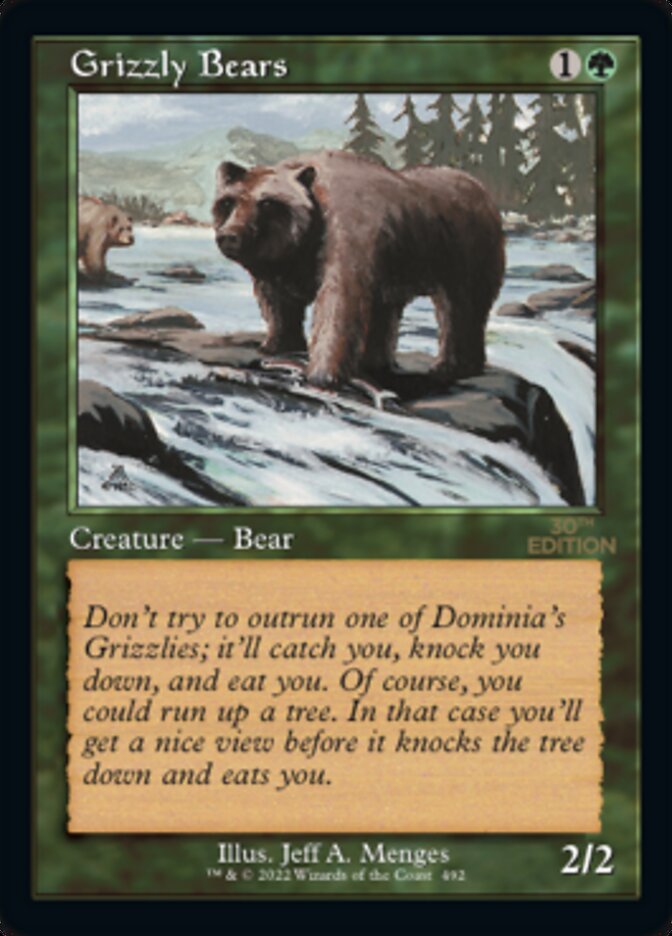
Attackers
You declare Grizzly Bears as an attacker. What happens to the creature, and what has to be true beforehand?
Keys A to D or click. No time limit.
Attackers must be untapped. As they are declared they become tapped, as a consequence of attacking, not as a cost. So there is no way to "avoid" the tapping, unless the creature has vigilance. A tapped creature can never attack, not even with haste.
508.1aThe active player chooses which creatures that they control, if any, will attack. The chosen creatures must be untapped, they can’t also be battles, and each one must either have haste or have been controlled by the active player continuously since the turn began.
508.1fThe active player taps the chosen creatures. Tapping a creature when it’s declared as an attacker isn’t a cost; attacking simply causes creatures to become tapped.
Cards involved
Attackers
Statement
„I cast Grizzly Bears in main phase 1. Since I am still in the same turn, the Bears may attack in this combat. "
Pick an answer — then move on.
A creature may only attack if you have controlled it continuously since the beginning of your current turn, or if it has haste. Cast in main phase 1 means it entered after the turn began, so it can't attack until your next turn. That applies to every creature, whether cast, created as a token or taken from your opponent.
508.1aThe active player chooses which creatures that they control, if any, will attack. The chosen creatures must be untapped, they can’t also be battles, and each one must either have haste or have been controlled by the active player continuously since the turn began.
302.6A creature’s activated ability with the tap symbol or the untap symbol in its activation cost can’t be activated unless the creature has been under its controller’s control continuously since their most recent turn began. A creature can’t attack unless it has been under its controller’s control continuously since their most recent turn began. This rule is informally called the “summoning sickness” rule.
702.10bIf a creature has haste, it can attack even if it hasn’t been controlled by its controller continuously since their most recent turn began. (See rule 302.6.)
Attackers
You are in the declare attackers step. How does the declaration work?
Keys A to D or click. No time limit.
Declaring attackers is a turn-based action: all at once, no stack, no response window in between. Only afterwards is priority given, first to you as the active player. No attacker can be added later. Anyone who wants to act before the declaration (say, tap a creature) has to do so in the beginning of combat step.
508.1First, the active player declares attackers. This turn-based action doesn’t use the stack. To declare attackers, the active player follows the steps below, in order. If at any point during the declaration of attackers, the active player is unable to comply with any of the steps listed below, the declaration is illegal; the game returns to the moment before the declaration (see rule 733, “Handling Illegal Actions”).
508.2Second, the active player gets priority. (See rule 117, “Timing and Priority.”)
Cards involved
Attackers
You attack with Grizzly Bears. What may the attack target be?
Keys A to D or click. No time limit.
Players, planeswalkers or battles can be attacked. As you declare attackers, you say for each one what it attacks. Your opponent's creatures only get involved if your opponent declares them as blockers. That is why you can't deliberately "attack" an opposing creature to get rid of it.
506.3Only a creature can attack or block. Only a player, a planeswalker, or a battle can be attacked.
508.1bIf the defending player controls any planeswalkers, is the protector of any battles, or the game allows the active player to attack multiple other players, the active player announces which player, planeswalker, or battle each of the chosen creatures is attacking.
Attackers
Statement
„After I have declared attackers and my opponent reveals a surprising blocker, I may still withdraw a creature from the attack. "
Pick an answer — then move on.
The declaration is final. A creature only leaves combat in specific cases (506.4), for example if an effect explicitly removes it from combat, if it leaves the battlefield or phases out, changes controller, regenerates or stops being a creature. Being untapped afterwards changes nothing: it remains attacking. Blockers are declared after attackers anyway; surprises are part of the game.
508.1First, the active player declares attackers. This turn-based action doesn’t use the stack. To declare attackers, the active player follows the steps below, in order. If at any point during the declaration of attackers, the active player is unable to comply with any of the steps listed below, the declaration is illegal; the game returns to the moment before the declaration (see rule 733, “Handling Illegal Actions”).
506.4A permanent is removed from combat if it leaves the battlefield, if its controller or protector changes, if it phases out, if an effect specifically removes it from combat, if it’s a planeswalker that’s being attacked and stops being a planeswalker, if it’s a battle that’s being attacked and stops being a battle, or if it’s an attacking or blocking creature that regenerates (see rule 701.19), stops being a creature, or becomes a battle. A creature that’s removed from combat stops being an attacking, blocking, blocked, and/or unblocked creature. A planeswalker or battle that’s removed from combat stops being attacked.
Cards involved

Blockers
Your opponent attacks with Centaur Courser (3/3). You have untapped Grizzly Bears. What applies to blocking?
Keys A to D or click. No time limit.
Blockers must be untapped, but blocking doesn't tap them. That is the difference from attacking. Summoning sickness plays no role in blocking: a creature that just entered may block right away. That is why going into your opponent's turn with untapped creatures is so valuable.
509.1aThe defending player chooses which creatures they control, if any, will block. The chosen creatures must be untapped and they can’t also be battles. For each of the chosen creatures, the defending player chooses one creature for it to block that’s attacking that player, a planeswalker they control, or a battle they protect.
Cards involved

Blockers
Your opponent attacks with Centaur Courser (3/3). You control Grizzly Bears (2/2) and Hill Giant (3/3). How may you block?
Keys A to D or click. No time limit.
Double blocks are allowed: any number of blockers on one attacker. Conversely, each creature normally blocks only one attacker. The blocked attacker divides its combat damage among the blockers however its controller likes, with no fixed order since 2024. With 3 damage the Courser can kill the Bears (2) and give the Giant 1, or put everything on one.
509.1aThe defending player chooses which creatures they control, if any, will block. The chosen creatures must be untapped and they can’t also be battles. For each of the chosen creatures, the defending player chooses one creature for it to block that’s attacking that player, a planeswalker they control, or a battle they protect.
510.1cA blocked creature assigns its combat damage to the creatures blocking it. If no creatures are currently blocking it (if, for example, they were destroyed or removed from combat), it assigns no combat damage. If exactly one creature is blocking it, it assigns all its combat damage to that creature. If two or more creatures are blocking it, it assigns its combat damage to those creatures divided as its controller chooses among them.
Cards involved

Blockers
Your opponent attacks with Centaur Courser, you block with Grizzly Bears. Your opponent then casts Lightning Bolt on the Bears and they die before combat damage. What happens to the Courser?
Keys A to D or click. No time limit.
Once a blocker is declared, the attacker is "blocked", and it stays that way until the end of combat, even if all blockers disappear. A blocked attacker without blockers deals no combat damage, unless it has trample. Killing the blocker in response gains the attacker no damage to you; it only saves the attacker from the blocker's damage.
509.1hAn attacking creature with one or more creatures declared as blockers for it becomes a blocked creature; one with no creatures declared as blockers for it becomes an unblocked creature. This remains unchanged until the creature is removed from combat, an effect says that it becomes blocked or unblocked, or the combat phase ends, whichever comes first. A creature remains blocked even if all the creatures blocking it are removed from combat.
510.1cA blocked creature assigns its combat damage to the creatures blocking it. If no creatures are currently blocking it (if, for example, they were destroyed or removed from combat), it assigns no combat damage. If exactly one creature is blocking it, it assigns all its combat damage to that creature. If two or more creatures are blocking it, it assigns its combat damage to those creatures divided as its controller chooses among them.
Cards involved


Blockers
Your opponent attacks with Air Elemental (4/4, flying). You control Giant Spider (2/4, reach) and Grizzly Bears (2/2). Who may block?
Keys A to D or click. No time limit.
Flying is an evasion ability: only creatures with flying or reach may block. Reach exists exactly for that, without flying itself. In the other direction there is no restriction: a flying creature may block any creature, with or without flying.
702.9bA creature with flying can’t be blocked except by creatures with flying and/or reach. A creature with flying can block a creature with or without flying. (See rule 509, “Declare Blockers Step,” and rule 702.17, “Reach.”)
702.17bA creature with flying can’t be blocked except by creatures with flying and/or reach. (See rule 509, “Declare Blockers Step,” and rule 702.9, “Flying.”)
Cards involved

Blockers
Statement
„Boggart Brute (3/2, menace) can't be blocked by a single creature. If I want to block, I need at least two blockers. "
Pick an answer — then move on.
Menace means: can't be blocked except by two or more creatures. A single blocker is not allowed, no matter how big it is. With two blockers the block is legal, and the Brute divides its 3 damage among them. If you have only one untapped creature, you have to take the damage.
Cards involved
Combat damage
You attack with Centaur Courser (3/3), your opponent blocks with Hill Giant (3/3). No keywords, no tricks. What happens in the combat damage step?
Keys A to D or click. No time limit.
Without first strike or double strike, all combat damage is dealt simultaneously. There is no priority window in between. Afterwards the game checks state-based actions: both 3/3s have 3 damage, both die. Whoever wants to "survive" combat needs first strike, more toughness or a trick before damage.
510.2Second, all combat damage that’s been assigned is dealt simultaneously. This turn-based action doesn’t use the stack. No player has the chance to cast spells or activate abilities between the time combat damage is assigned and the time it’s dealt.
510.1aEach attacking creature and each blocking creature assigns combat damage equal to its power. Creatures that would assign 0 or less damage this way don’t assign combat damage at all.
Cards involved

Combat damage
You attack with Grizzly Bears (2/2), your opponent blocks with Youthful Knight (2/1, first strike). What happens?
Keys A to D or click. No time limit.
As soon as a creature with first strike or double strike is in combat, the combat phase gets two damage steps. In the first, only creatures with first strike or double strike deal damage; in the second, the rest. State-based actions are checked between the steps, and by then the Bears are already dead. First strike works the same when attacking and when blocking.
702.7bIf at least one attacking or blocking creature has first strike or double strike (see rule 702.4) as the combat damage step begins, the only creatures that assign combat damage in that step are those with first strike or double strike. After that step, instead of proceeding to the end of combat step, the phase gets a second combat damage step. The only creatures that assign combat damage in that step are the remaining attackers and blockers that had neither first strike nor double strike as the first combat damage step began, as well as the remaining attackers and blockers that currently have double strike. After that step, the phase proceeds to the end of combat step.
510.4If at least one attacking or blocking creature has first strike (see rule 702.7) or double strike (see rule 702.4) as the combat damage step begins, the only creatures that assign combat damage in that step are those with first strike or double strike. After that step, instead of proceeding to the end of combat step, the phase gets a second combat damage step. The only creatures that assign combat damage in that step are the remaining attackers and blockers that had neither first strike nor double strike as the first combat damage step began, as well as the remaining attackers and blockers that currently have double strike. After that step, the phase proceeds to the end of combat step.
Cards involved

Combat damage
You attack with Craw Wurm (6/4), your opponent blocks with Grizzly Bears (2/2) and Hill Giant (3/3). How do you divide the 6 damage?
Keys A to D or click. No time limit.
When a creature is blocked by several creatures, its controller divides the combat damage among the blockers freely. The old damage assignment order rule was removed in late 2024. You don't have to assign lethal damage to any blocker either. Conversely, both blockers assign their damage to the Wurm: 2 + 3 = 5 damage, and the 6/4 dies too.
510.1cA blocked creature assigns its combat damage to the creatures blocking it. If no creatures are currently blocking it (if, for example, they were destroyed or removed from combat), it assigns no combat damage. If exactly one creature is blocking it, it assigns all its combat damage to that creature. If two or more creatures are blocking it, it assigns its combat damage to those creatures divided as its controller chooses among them.
Cards involved

Combat damage
You attack with Colossal Dreadmaw (6/6, trample), your opponent blocks with Grizzly Bears (2/2). How much damage does your opponent take?
Keys A to D or click. No time limit.
Trample: first, lethal damage must be assigned to each blocker, counting damage already marked. Anything beyond that may go to the attacked player or planeswalker. You may give the blockers more, but you don't have to. Here: 2 to the Bears, 4 to your opponent is the maximum.
702.19bThe controller of an attacking creature with trample first assigns damage to the creature(s) blocking it. Once all those blocking creatures are assigned lethal damage, any excess damage is assigned as its controller chooses among those blocking creatures and the player, planeswalker, or battle the creature is attacking. When checking for assigned lethal damage, take into account damage already marked on the creature and damage from other creatures that’s being assigned during the same combat damage step, but not any abilities or effects that might change the amount of damage that’s actually dealt. The attacking creature’s controller need not assign lethal damage to all those blocking creatures but in that case can’t assign any damage to the player or planeswalker it’s attacking.
Combat damage
Statement
„Damage dealt to a creature stays marked on it until the end of the game. "
Pick an answer — then move on.
Marked damage remains until the cleanup step of the current turn. There, all damage is removed from all permanents, at the same time as all "until end of turn" effects end. A creature with 2 damage at the end of your turn is unharmed again in your opponent's turn. That is why a 3/3 with 2 damage can still be killed with 1 damage this turn.
120.6Damage marked on a creature remains until the cleanup step, even if that permanent stops being a creature. If the total damage marked on a creature is greater than or equal to its toughness, that creature has been dealt lethal damage and is destroyed as a state-based action (see rule 704). All damage marked on a permanent is removed when it regenerates (see rule 701.19, “Regenerate”) and during the cleanup step (see rule 514.2).
514.2Second, the following actions happen simultaneously: all damage marked on permanents (including phased-out permanents) is removed and all “until end of turn” and “this turn” effects end. This turn-based action doesn’t use the stack.
Cards involved
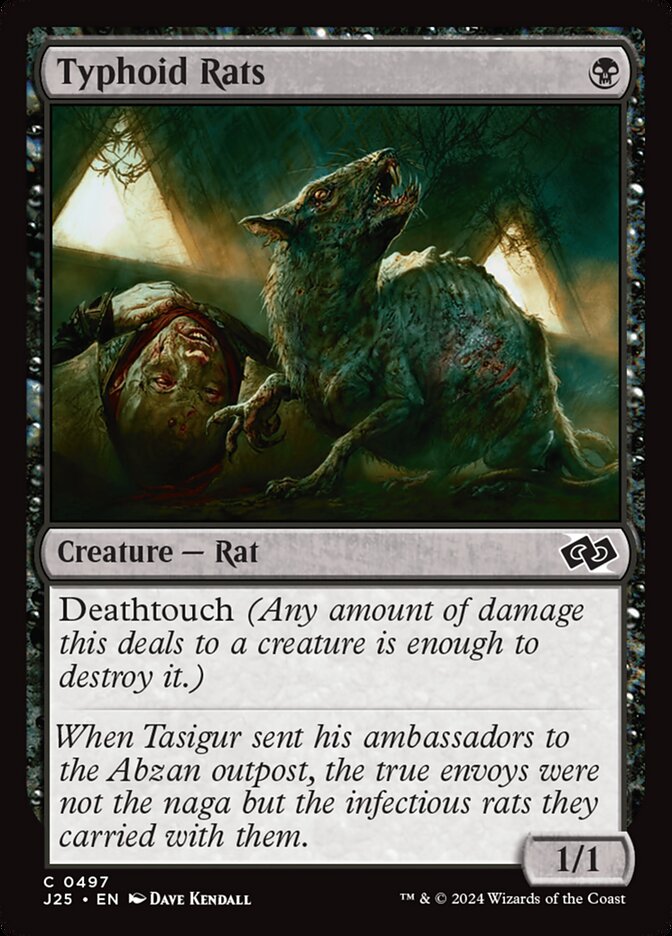
Keywords
Your opponent attacks with Craw Wurm (6/4). You block with Typhoid Rats (1/1, deathtouch). What happens?
Keys A to D or click. No time limit.
Any amount of damage from a source with deathtouch destroys the creature as a state-based action, no matter its toughness. The Rats' 1 damage is enough for the Wurm. Deathtouch doesn't protect its own creature: the Wurm's 6 damage kills the Rats. Combat damage is simultaneous, so both die.
702.2bA creature with toughness greater than 0 that’s been dealt damage by a source with deathtouch since the last time state-based actions were checked is destroyed as a state-based action. See rule 704.
704.5hIf a creature has toughness greater than 0, and it’s been dealt damage by a source with deathtouch since the last time state-based actions were checked, that creature is destroyed. Regeneration can replace this event.
Cards involved
Keywords
Your opponent attacks with Colossal Dreadmaw (6/6, trample). You block with Typhoid Rats (1/1, deathtouch). What happens?
Keys A to D or click. No time limit.
Trample only requires lethal damage for the blocker: for a 1/1 that is 1 damage, the remaining 5 may go to you. Still the block isn't wasted: combat damage is simultaneous, and the Rats' 1 damage carries deathtouch. The Dreadmaw is destroyed. A 1/1 with deathtouch trades with almost any creature this way.
702.19bThe controller of an attacking creature with trample first assigns damage to the creature(s) blocking it. Once all those blocking creatures are assigned lethal damage, any excess damage is assigned as its controller chooses among those blocking creatures and the player, planeswalker, or battle the creature is attacking. When checking for assigned lethal damage, take into account damage already marked on the creature and damage from other creatures that’s being assigned during the same combat damage step, but not any abilities or effects that might change the amount of damage that’s actually dealt. The attacking creature’s controller need not assign lethal damage to all those blocking creatures but in that case can’t assign any damage to the player or planeswalker it’s attacking.
702.2bA creature with toughness greater than 0 that’s been dealt damage by a source with deathtouch since the last time state-based actions were checked is destroyed as a state-based action. See rule 704.
510.2Second, all combat damage that’s been assigned is dealt simultaneously. This turn-based action doesn’t use the stack. No player has the chance to cast spells or activate abilities between the time combat damage is assigned and the time it’s dealt.
Cards involved

Keywords
You attack with Child of Night (2/1, lifelink), your opponent blocks with Grizzly Bears (2/2). What happens to your life total?
Keys A to D or click. No time limit.
Lifelink is a static ability: damage from the source makes its controller gain that much life at the same time. No trigger, no stack, no response possible. All damage counts, including damage to creatures, and even if the source dies in the same moment. Child of Night deals 2 and dies to the Bears' 2; you have 2 more life.
702.15bDamage dealt by a source with lifelink causes that source’s controller, or its owner if it has no controller, to gain that much life (in addition to any other results that damage causes). See rule 120.3.
510.2Second, all combat damage that’s been assigned is dealt simultaneously. This turn-based action doesn’t use the stack. No player has the chance to cast spells or activate abilities between the time combat damage is assigned and the time it’s dealt.
Cards involved

Keywords
Statement
„Serra Angel (4/4, flying, vigilance) attacks, stays untapped while doing so, and can block normally during your opponent's next turn. "
Pick an answer — then move on.
Vigilance means attacking doesn't cause the creature to tap. It still attacks fully and deals damage. Because it stays untapped, it is ready as a blocker on your opponent's turn, and its  abilities remain usable too. Vigilance does not, however, allow attacking with an already tapped creature.
Cards involved

Keywords
You attack with Grizzly Bears (2/2), your opponent blocks with Fencing Ace (1/1, double strike). What happens?
Keys A to D or click. No time limit.
Double strike means damage in the first-strike step AND in the regular step, each at full power. The Ace deals 1 + 1. After the first step the Bears have 1 damage and live; in the second step both deal damage simultaneously: the Ace dies to 2, the Bears reach 2 damage and die as well. Double strike doesn't double power; it doubles the number of hits.
702.4bIf at least one attacking or blocking creature has first strike (see rule 702.7) or double strike as the combat damage step begins, the only creatures that assign combat damage in that step are those with first strike or double strike. After that step, instead of proceeding to the end of combat step, the phase gets a second combat damage step. The only creatures that assign combat damage in that step are the remaining attackers and blockers that had neither first strike nor double strike as the first combat damage step began, as well as the remaining attackers and blockers that currently have double strike. After that step, the phase proceeds to the end of combat step.
510.4If at least one attacking or blocking creature has first strike (see rule 702.7) or double strike (see rule 702.4) as the combat damage step begins, the only creatures that assign combat damage in that step are those with first strike or double strike. After that step, instead of proceeding to the end of combat step, the phase gets a second combat damage step. The only creatures that assign combat damage in that step are the remaining attackers and blockers that had neither first strike nor double strike as the first combat damage step began, as well as the remaining attackers and blockers that currently have double strike. After that step, the phase proceeds to the end of combat step.